

With the evolution of caregiving concepts and the widespread adoption of assistive devices, patient transfer lifters have become essential tools in hospitals, nursing homes, rehabilitation centers, and home care settings. These lifts are widely used to enhance patient safety, reduce the physical strain on caregivers, and improve transfer efficiency.
Different models of patient transfer lifts vary in terms of structure, power source, intended use, support mechanisms, and key functions; therefore, understanding the different categories is crucial for selecting the right equipment.
This article provides a systematic overview of the types of patient transfer lifters, detailing the structural characteristics, advantages, use cases, and functional differences of each type to help users make informed decisions and choose the most suitable product.
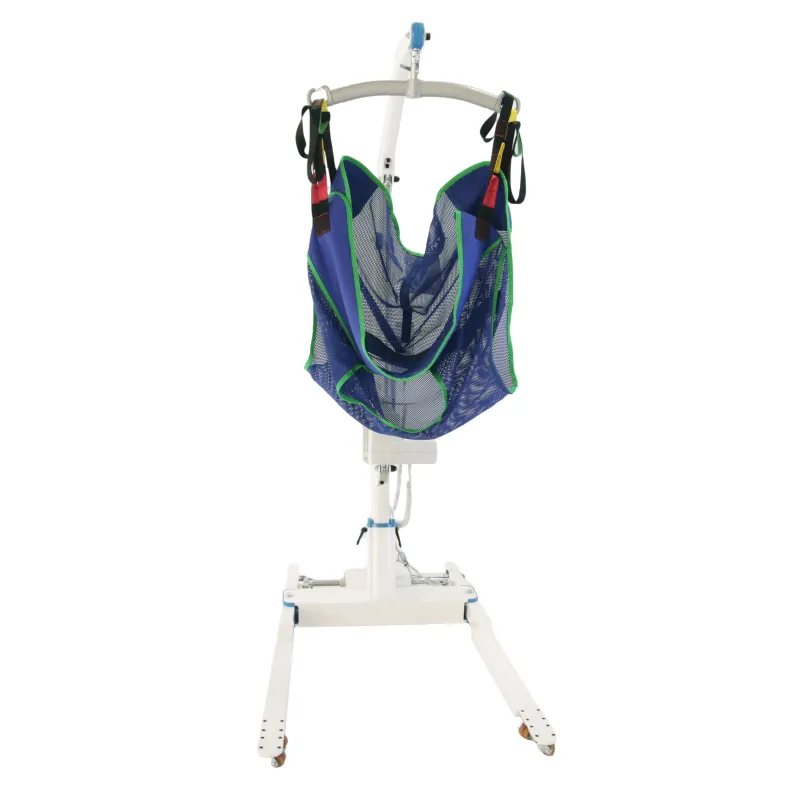
Why are patient transfer lifters categorized?
The variety of patient transfer lifters exists because different patient conditions, caregiving scenarios, and environmental layouts require specific equipment features.
For example:
• Some patients require full support via a sling.
• Some patients retain a certain ability to stand.
• Some environments have limited space.
• Some scenarios require transfers between different facilities, such as beds, wheelchairs, and toilets.
Consequently, patient transfer lifters are classified into various types based on purpose, power source, support structure, and functional capabilities to maximize safety and caregiving efficiency.
What are the main categories of patient transfer lifts?
From the perspective of professional care equipment, patient transfer lifters can be broadly categorized as follows:
1. By power source
• Electric patient transfer lifters
• Hydraulic patient transfer lifters (manual hydraulic operation)
2. By function and structure
• General-purpose transfer lifts
• Stand-assist transfer lifts
• Over-bed transfer lifts
• Bathing transfer lifts
• Transfer lifts with integrated commode function
3. By usage scenario
• Hospital/institutional care
• Home care
• Rehabilitation training
The following section focuses on the most mainstream, common, and representative categories, providing a detailed explanation of electric, hydraulic, and integrated-commode patient transfer lifters.
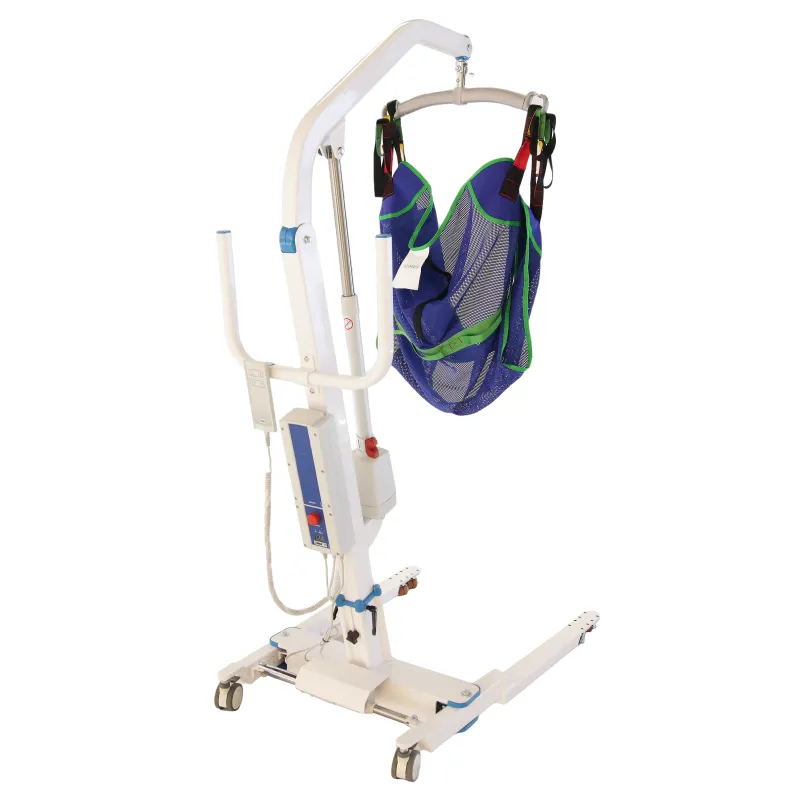
What is an electric patient transfer lifter? What are its features?
Electric patient transfer lifters are among the most commonly used models in care facilities and homes today. They utilize a motor to drive the lifting mechanism and are controlled via buttons, making operation easy and safe.
Key features of electric patient transfer lifters include:
1. Electric lifting operation; no physical exertion required
Caregivers can perform lifting actions using a hand control or buttons.
2. Smooth lifting and low noise
Suitable for long-term care, nighttime care, and scenarios requiring frequent transfers.
3. High load-bearing capacity
Most electric patient transfer lifters offer superior weight capacities compared to manual models.
4. Better suited for single-person operation
Since the lifting action is performed by the motor, the caregiver only needs to manage the direction and the sling.
5. Suitable for a wide range of scenarios
Includes bed-to-chair transfers, wheelchair transfers, toileting assistance, and repositioning in rehabilitation settings.
6. Enhanced safety features
Typically equipped with features such as an emergency descent button, accidental activation protection, and battery level alerts.
Therefore, electric patient transfer lifts are ideal for:
• Households where caregivers have limited physical strength
• High-intensity care environments (institutions)
• Patients requiring frequent transfers
• Long-term bedridden individuals
What is a hydraulic patient transfer lift? What are its advantages?
Hydraulic patient lifts rely on a foot-operated hydraulic pump for lifting and lowering; this is a traditional yet highly reliable method of patient transfer.
Key features of hydraulic patient lifters include:
1. No electricity required
Ready for immediate use without the need to manage charging.
2. Stable structure and affordable cost
They feature a simple mechanical design and low maintenance costs.
3. Controlled lifting process
Slow, controlled lifting and lowering achieved via a foot pedal.
4. Suitable for both home and institutional use
Ideal for environments with limited budgets that still require high-load transfer capabilities.
5. Minimal environmental requirements
They do not rely on a power source and will not become inoperable due to motor failure.
Although hydraulic patient lifters require some physical effort to operate, they are widely used due to their proven design, safety, and efficiency.
Target users include:
• Families with limited budgets
• Situations requiring temporary use
• Short-term care needs
• Patients who do not require frequent transfers
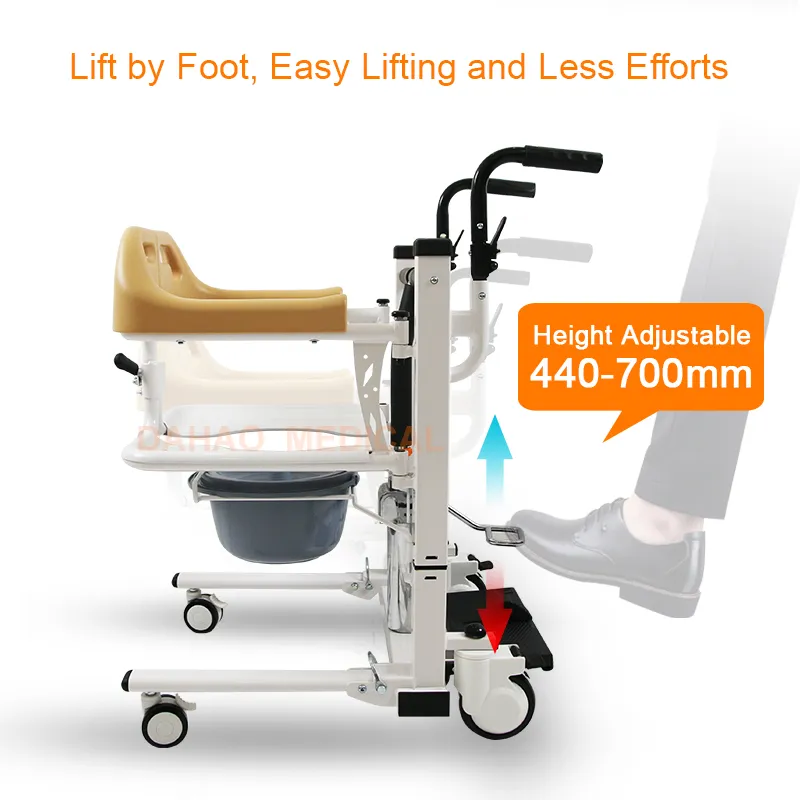
What is a patient lifter with a built-in commode function, and why is it widely used?
In caregiving settings, transferring a patient for toileting is often one of the most difficult, dangerous, and physically demanding tasks. To address this, many manufacturers have introduced patient lifters that feature a built-in commode.
These models typically feature:
• A removable seat center
• Space underneath to place a portable commode bucket
• The ability to position the patient directly over a standard toilet
Features of patient lifters with built-in commodes include:
1. Integrated toileting function
Reduces the need for caregivers to perform multiple lifting and transfer maneuvers.
2. Suitable for patients with moderate to severe mobility impairments
Especially for those who cannot stand or lack stability when standing.
3. Integrated lifting and mobility functions
Combines transfer and toileting capabilities in a single, versatile device.
4. Enhances self-care ability
Reduces unnecessary feelings of embarrassment and dependency.
5. One of the most practical models for home use
Particularly suitable for homes with narrow bathrooms where installing grab bars is not feasible.
Patient lifters with built-in commodes are available in both electric and hydraulic versions, though electric models are more common.
How do universal patient lifters differ from other models?
General-purpose patient lifters—also known as "full-function lifts"—are suitable for a wide range of scenarios, including transfers between beds and chairs, lifting patients from the floor, and repositioning.
Key features of general-purpose patient lifts include:
• Wide lifting range
• Adjustable base width
• Sling supports adaptable to various body positions
• Compatibility with beds, wheelchairs, standard chairs, toilets, and other facilities
Most general-purpose models support single-operator use and serve as essential equipment for hospitals and nursing facilities.
What is a stand-assist patient lifter, and what is its function?
Stand-assist patient lifters are also known as "partial-weight-bearing lifts" or "standing aid lifts."
Stand-assist patient lifters are suitable for patients who:
• Can bear some weight while standing independently
• Require assistance with standing, toileting, or sit-to-stand transfers
• Have weak lower-limb strength but are not completely bedridden
Key features of stand-assist patient lifters include:
• Helping patients stand with caregiver assistance
• Aiding in the maintenance of lower-limb mobility
• Supporting short-distance transfers (e.g., bed-to-chair or chair-to-toilet)
• Typically utilizing knee pads or underarm supports rather than full-body slings
Stand-assist lifts are ideal for rehabilitation settings and for patients who retain some ability to care for themselves.
In what scenarios are bathing patient lifts used?
Bathing lifters typically feature waterproof materials and non-slip designs, allowing for safe use in humid environments like bathrooms.
Key features of bathing patient lifters include:
• Non-slip casters
• Waterproof slings
• Corrosion-resistant structure
• Safe execution of transfers within the bathroom
Bathing patient lifters are suitable for:
• Transfers related to bathing
• Use in confined bathroom spaces
While bathing lifts are most commonly found in nursing facilities, compact models suitable for home use are also available.
What do the different types of patient lifters have in common?
Whether electric, hydraulic, stand-assist, or commode-integrated, they all share several key objectives:
• Reducing the physical strain on caregivers
• Enhancing safety during patient transfers
• Preventing secondary injuries and falls
• Improving quality of life and comfort
• Increasing care efficiency and consistency
Therefore, selecting the right type is crucial.
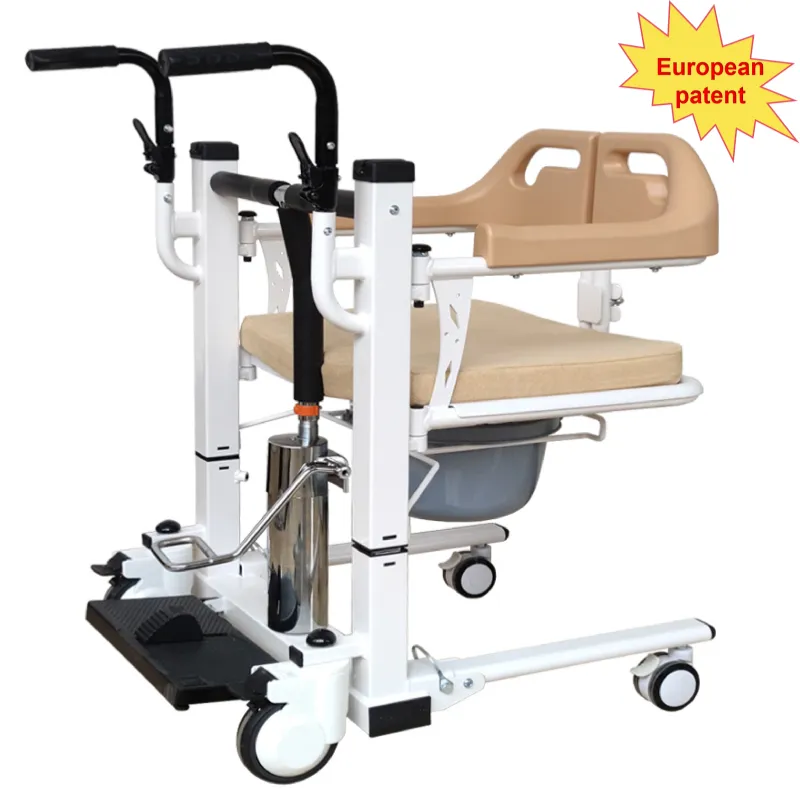
What key factors should be considered when choosing a patient transfer lifter?
To ensure the lifter performs effectively, focus on the following aspects:
1. Power type (electric vs. hydraulic)
Decide based on the need to conserve physical effort.
2. Need for toileting or bathing functions
Determine whether a commode-integrated or bathing-compatible model is required.
3. Patient's physical condition
Different models are suitable for patients who are completely bedridden, capable of partial standing, semi-dependent, or fully dependent.
4. Number and strength of caregivers
Electric models are better suited for single-caregiver operation.
5. Room and bathroom dimensions
Select a model with an appropriate base width and overall size.
6. Sling type and weight capacity
Ensure the sling meets specific care requirements.
7. Brand and safety certifications
Ensure compliance with care equipment standards.
By comparing the features of various patient transfer lifters, you can more clearly determine the most suitable model.