

When purchasing an electric wheelchair, users often focus on parameters such as weight, battery life, battery performance, and material structure. However, one extremely important yet easily overlooked indicator is its top speed.
Especially in recent years, with the increasing popularity of lightweight carbon fiber power wheelchairs, speed performance has gradually become a key comparison point for users.
So, what exactly is the top speed of a carbon fiber electric wheelchair?
Why are some carbon fiber electric wheelchairs faster than others?
Is higher speed always better?
What factors affect speed?
This article will systematically analyze these questions from a professional perspective, combining industry standards and product performance patterns to provide users with a comprehensive, easy-to-understand, and authoritative reference guide.
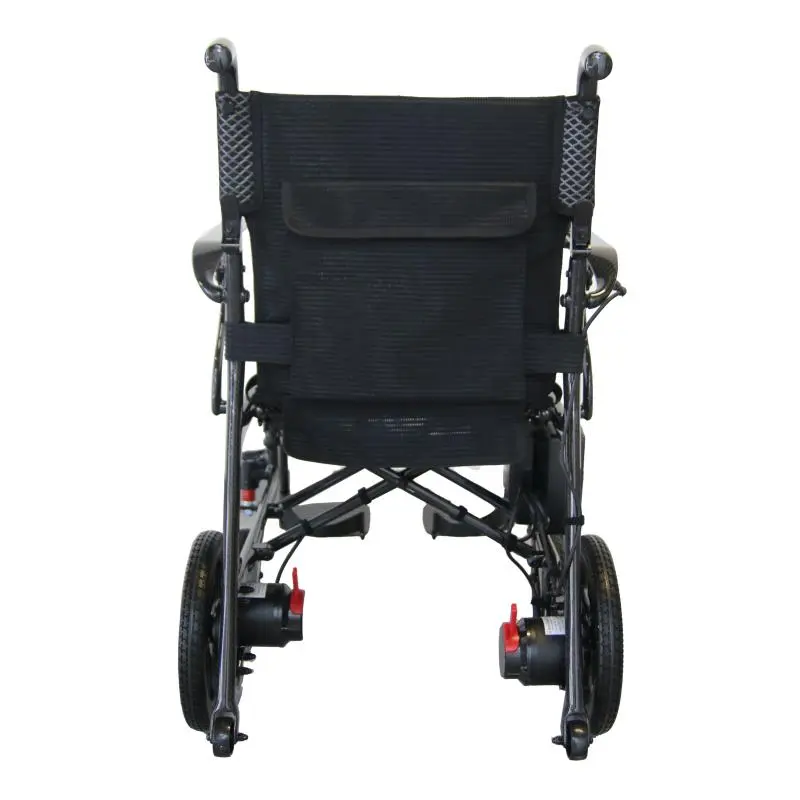
What is the typical top speed achievable by carbon fiber electric wheelchairs?
From the perspectives of industry standards, structural design, and motor configuration, the top speed of carbon fiber electric wheelchairs is typically between 4 km/h and 6 km/h.
Although there may be slight differences in speed between different brands and models, the range is not significant.
This is because:
1. Electric wheelchairs are classified as medical assistive mobile devices.
2. Their maximum speed is limited by regulations and safety standards.
3. They are designed for mixed indoor and outdoor use.
4. Network transportation, urban roads, and public environments all have strict speed requirements.
For example, the ultralight carbon fiber electric wheelchair from the Chinese manufacturer Dayang Medical weighs only 13.5kg (12kg without the battery) but has a load capacity of up to 136kg. Using 6Ah and 10Ah lithium batteries, its maximum speed is 4.5 km/h, fully meeting the industry's upper speed limit standard.
Therefore, the common speed of carbon fiber electric wheelchairs is approximately 4.5 km/h, an ideal speed balancing safety and efficiency.
Why is the maximum speed of carbon fiber power wheelchairs usually limited to no more than 6 km/h?
Many users wonder:
"Since it's a high-performance material, why can't carbon fiber power wheelchairs go faster?"
"The motor could be much stronger, so why is the speed set lower?"
These questions stem from a lack of understanding of the reasons for speed limitations. In reality, carbon fiber power wheelchairs have low speeds to ensure safety, stability, and maneuverability. The main reasons are as follows:
1. Mandatory Speed Limits for Medical Assistive Devices
Globally, electric wheelchairs are classified as medical assistive mobile devices (Mobility Aid), not mobility scooters or electric vehicles. Therefore:
• Excessive speed increases the risk of accidents
• Safety must be ensured in public areas such as sidewalks, shopping malls, and airports
• Regulations in various countries typically stipulate that the maximum speed of electric wheelchairs should not exceed a specified range.
Therefore, most electric wheelchairs have a maximum speed limit of 6 km/h or less.
2. The Extremely Lightweight Structure Needs to Ensure Handling Stability
The carbon fiber body itself is very light. To avoid the following at high speeds:
• Instability during steering
• Increased bouncing
• Shifting center of gravity
• Increased braking distance
Manufacturers reasonably limit their peak speed.
3. Balancing Motor Power and Range
Higher speed:
• Faster power consumption
• Higher control system temperature
• Greater battery load
To maintain the core advantages of lightweight and long range in carbon fiber electric wheelchairs, their speed must not come at the expense of safety and battery life.
In summary, the structural characteristics of carbon fiber electric wheelchairs dictate that their speed cannot be increased indefinitely, but should be kept within a safe range of 4–6 km/h.
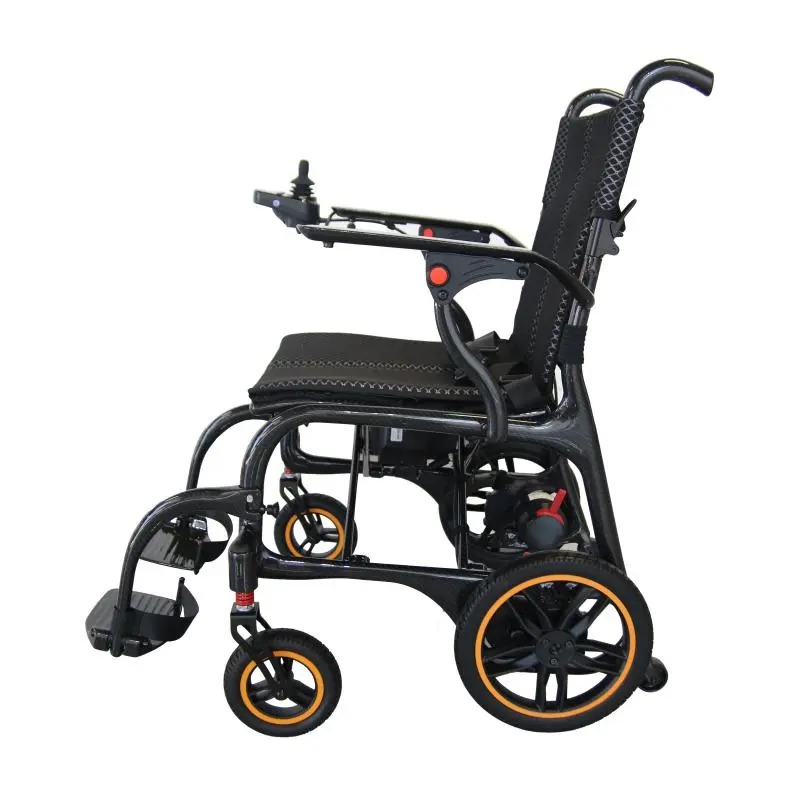
What factors determine the maximum speed of a carbon fiber power wheelchair?
Although most carbon fiber power wheelchairs have similar speeds, in specific designs, more than ten factors determine their speed, including:
1. Motor Power and Torque Output
The motor is the core source of speed; the higher the parameters, the higher the speed.
However, an excessively powerful motor may lead to:
• Increased difficulty of operation
• Reduced range
• Mismatch in the load-bearing capacity of the carbon fiber frame
Therefore, manufacturers often set the speed within a reasonable range.
2. Wheel Diameter
Larger wheels:
• Easier to overcome obstacles
• Smoother movement
• Higher potential for straight-line speed
However, smaller wheels are more suitable for indoor operation. Therefore, carbon fiber power wheelchairs typically opt for a configuration that balances stability and speed.
3. Vehicle Weight (Advantages of Carbon Fiber)
Carbon fiber electric wheelchairs possess:
• Ultra-light weight
• Extremely high rigidity
Theoretically, lighter weight helps improve acceleration performance, but to avoid loss of speed control due to excessive lightness, manufacturers usually maintain the speed within a safe range.
4. Control System (Electronic Control) Settings
Electrical control limitations include:
• Maximum output speed
• Acceleration
• Start-up sensitivity
• Braking force
To enhance safety, most carbon fiber power wheelchairs limit speed output.
5. Usage Scenarios
Carbon fiber electric wheelchairs are typically positioned for:
• Indoor use
• Medical institutions
• Urban roads
• Public spaces such as airports and shopping malls
Therefore, high speed is not required; instead, the following are necessary:
• Stability
• Lightweight
• Safety
This positioning also determines its speed range.
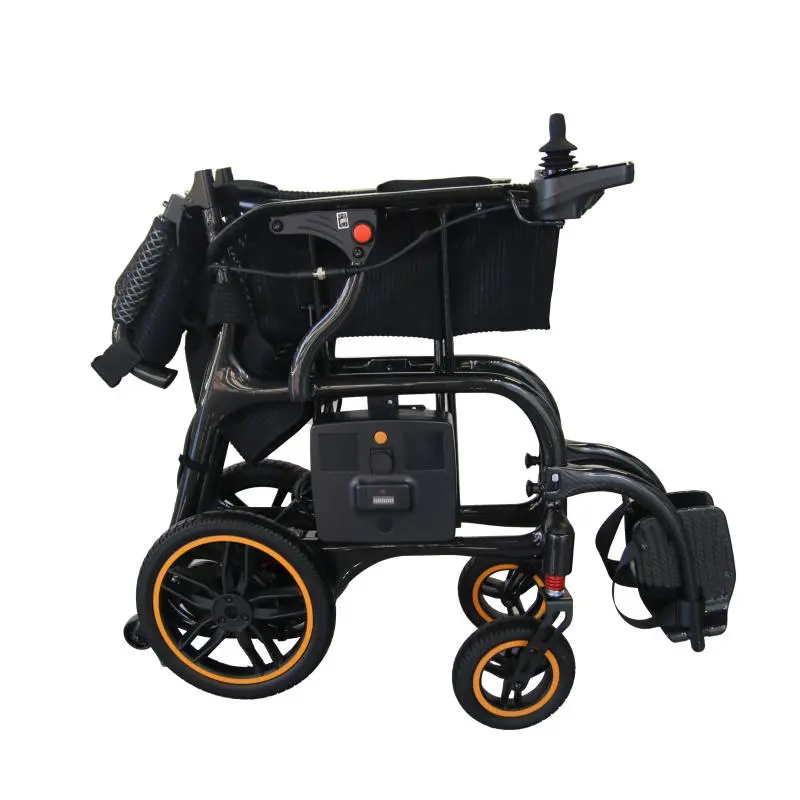
Is a higher maximum speed always better for carbon fiber power wheelchairs?
Many users believe that higher speed is always better, but this is a misconception.
The goal of an electric wheelchair is not speed, but stability.
From a professional perspective, excessively high speeds for carbon fiber power wheelchairs may actually lead to:
• Increased sensitivity in steering
• Disruption of posture and balance
• Accelerated battery consumption
• Inconvenient indoor operation
• Increased braking distance
Therefore, the "optimal" speed is not the highest possible value, but rather the "speed best suited for the mobility assistance scenario."
Carbon fiber electric wheelchairs are typically set at around 4.5 km/h to achieve the following:
• Maximized safety and stability
• Highest adaptability to various usage scenarios
• Optimal battery life balance
• Ease of use for beginners
• Comfortable operation
Therefore, a higher maximum speed is not necessarily better; a more "reasonable" speed is better.
What factors affect the speed of a carbon fiber power wheelchair in daily use?
Even with a nominal speed of 4.5 km/h or 5 km/h, the actual speed will vary depending on the environment, for example:
1. Road conditions
• Smooth roads: More stable speed
• Cobblestone roads: Slightly reduced speed
• Ramps: Reduced speed uphill, electronically limited speed downhill
2. User weight
The closer the user is to the maximum load capacity, the more significant the speed decrease.
Carbon fiber electric wheelchairs typically support a load of 100–150 kg, so speed fluctuations under heavy loads are normal.
3. Battery Level
The lower the battery level, the lower the output power, and the slower the speed.
4. Wind Resistance and Ambient Temperature
Although the impact is minor, it still causes a slight change in speed.
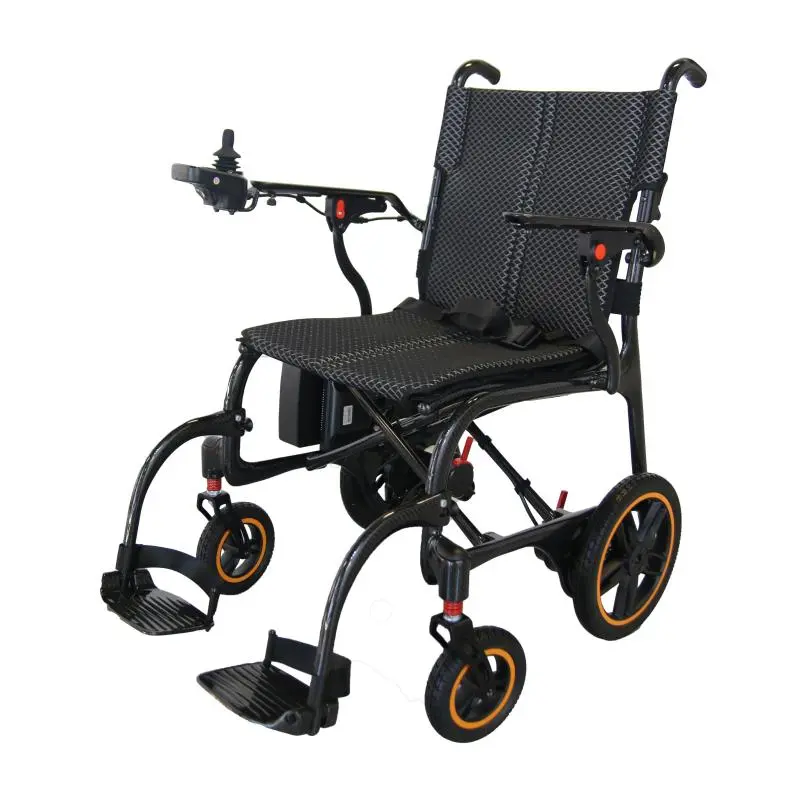
What is the relationship between speed and safety performance of carbon fiber power wheelchairs?
The design logic of electric wheelchairs is: Safety must take precedence over speed.
To adapt to more scenarios, the safety systems of carbon fiber power wheelchairs are closely related to speed, including:
• Anti-tipping system
• Electromagnetic braking
• Downhill speed limiting system
• Soft-start system
• Smooth acceleration program
These systems do not support high-speed operation, therefore the maximum speed of carbon fiber power wheelchairs remains within a reasonable range and will not increase indefinitely.
From a professional perspective, this is not only a safety necessity but also a regulatory requirement.
Why is there little difference in speed between different brands of carbon fiber power wheelchairs?
Many users have found that:
The speeds of different brands of carbon fiber power wheelchairs are similar, mostly between 4–6 km/h.
This is because:
• National regulations have standardized speed requirements.
• Primarily used for indoor and daily commuting, higher speeds are not required.
• Safety systems limit speed increases.
• Lightweight structures are not suitable for high-speed operation.
• Industry-standard motor power is largely uniform.
Therefore, the speed differences between Dayang Medical, other Chinese manufacturers, and overseas brands are not particularly significant.
The key competitive advantage of carbon fiber power wheelchairs lies not in speed, but in:
• Weight
• Battery performance
• Folding mechanism
• Durability
• Comfort
• Material strength
• Portability
Can Healthcare Facilities Purchase Hospital Beds from Dayang Medical?
Yes, Guangdong Dayang Medical Technology Co., Ltd. is a leading manufacturer and supplier of hospital beds, electric wheelchairs, manual wheelchairs, mobility scooters, walkers, commodes, shower chairs, and walking sticks. Since 2009, Dayang Medical has operated two R&D and production bases in Foshan, China, providing high-quality products with CE certification and ISO13485, ISO9001, FDA, and TUV approvals.