

With the increasing popularity of lightweight and portable designs in the electric wheelchair industry, carbon fiber power wheelchairs are becoming a new choice for more and more people.
Carbon fiber material not only boasts extremely high strength and ultra-light weight, but also gives electric wheelchairs advantages in folding, carrying, and transportation that traditional metal materials cannot match.
However, some users who are new to carbon fiber electric wheelchairs often have a very typical question:
"Since carbon fiber electric wheelchairs are so light, won't the center of gravity be unstable? Will it tip over?"
The answer is clear and firm:
No.
The lightweight nature of carbon fiber electric wheelchairs does not lead to an unstable center of gravity, nor will the light material cause them to tip over.
Whether an electric wheelchair is stable or not is not directly related to the weight of the material, but is closely related to various engineering parameters such as the vehicle structure, electronic control system, driving method, and anti-tip design.
This blog post will provide an in-depth analysis to help users truly understand why carbon fiber electric wheelchairs are not unstable due to their light weight and will not easily tip over.
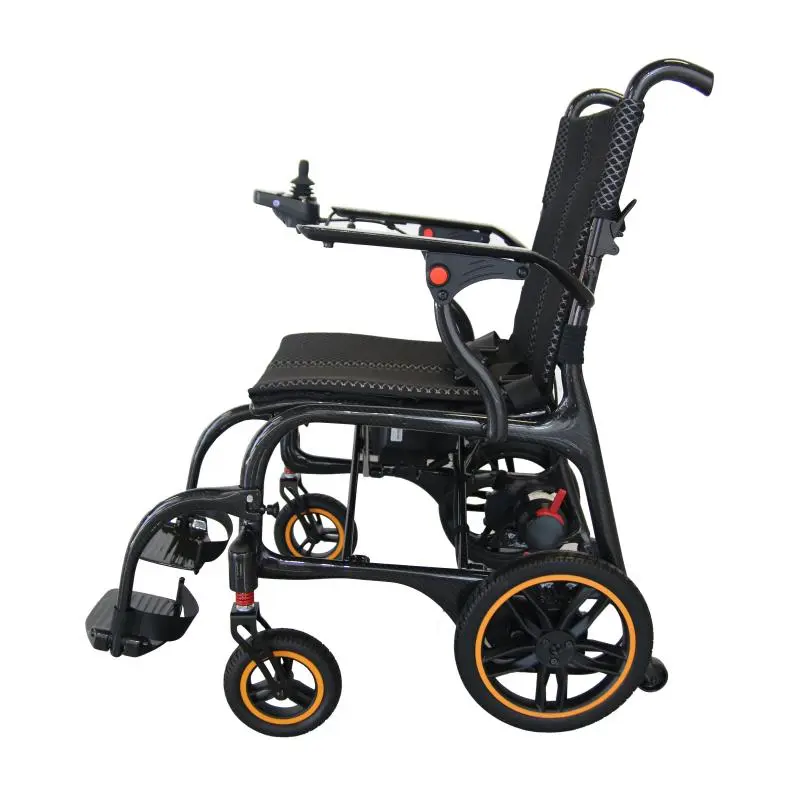
Why won't carbon fiber power wheelchairs tip over? What are the core reasons?
To answer the question of whether a carbon fiber power wheelchair will tip over, we must analyze it from an engineering structure perspective, not by speculating based on the weight of the material itself.
In fact, the main reasons why carbon fiber power wheelchairs do not tip over come from the following three engineering principles:
1. The center of gravity of an electric wheelchair is determined by the structural design, not the weight of the material
Although carbon fiber is light, the stability of the vehicle body is not determined by the material density, but by:
• Wheel layout
• Wheelbase length
• Steering structure
• Driving method
• Center of gravity position
• Seating position design
• Chassis height
Any qualified carbon fiber electric wheelchair undergoes extensive center of gravity distribution testing during the design phase to ensure that its center of gravity naturally falls within the safe zone between the wheels, not at the extreme upper, lower, front, or rear points.
Therefore, whether the material is light or not does not change the balance of the center of gravity.
Even if carbon fiber is lighter than aluminum alloy, it will not affect the stability of the wheelchair's center of gravity.
2. Carbon fiber itself has extremely high strength, and the frame will not deform due to stress, causing the center of gravity to shift
Many users hear "light" and mistakenly think "not stable enough."
This is a misunderstanding of the performance of carbon fiber materials. Carbon fiber has the following characteristics:
• 7-10 times stronger than steel
• High elastic modulus
• Strong resistance to pressure
• Not easily bent or deformed
• Extremely rigid
When the vehicle body encounters bumps, tilting, or braking, the stability of the carbon fiber frame is far superior to that of aluminum alloy or steel.
The frame will not deform due to impact or weight changes, so the center of gravity will not shift suddenly.
This means:
The body stability of a carbon fiber power wheelchair is more stable than traditional materials, not less stable.
3. Carbon fiber power wheelchairs are equipped with an anti-tilt system and an electronically controlled speed limiting system to prevent any risk of tipping over.
All electric wheelchairs (regardless of material) must be designed for stability according to medical device standards, including:
• Rear anti-tilt wheels
• Downhill speed limiting program
• Starting buffer system
• Emergency stop function
• Cornering speed limit
• Electromagnetic brakes
These systems ensure:
• No tipping backward on uphill slopes
• No rushing forward on downhill slopes
• No skidding during turns
• No tilting forward during acceleration
• No tilting when encountering obstacles
Therefore, with the dual protection of structural and electronic systems, carbon fiber power wheelchairs are inherently resistant to tipping over.
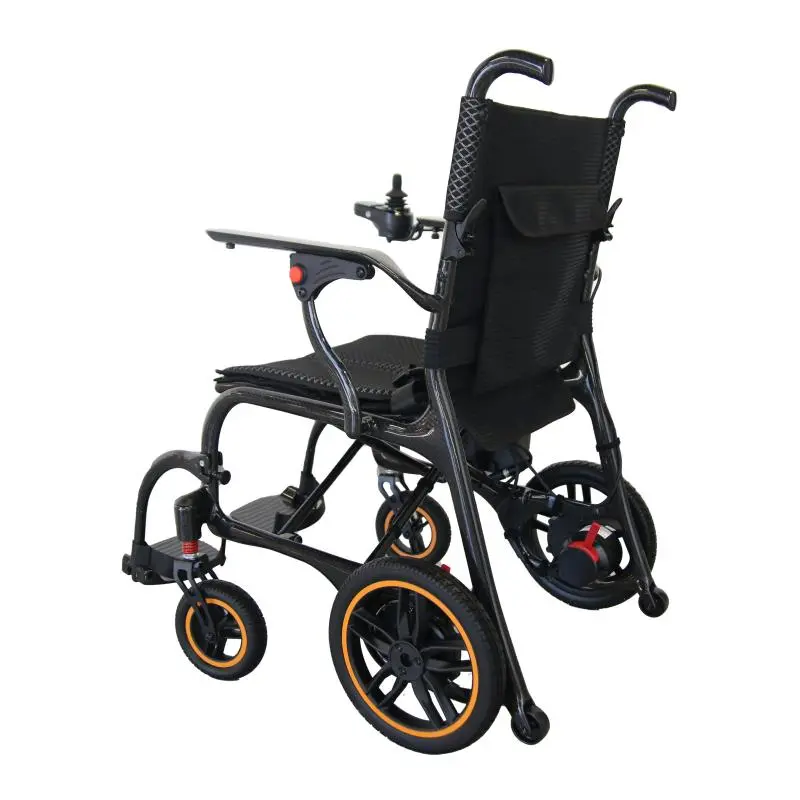
Will the lightness of carbon fiber power wheelchairs lead to a higher center of gravity?
Many users worry that lightweight design will raise the center of gravity, but this is not the case.
The height of the center of gravity is not determined by material density, but by sitting posture and chassis height.
The center of gravity of an electric wheelchair depends on:
• Seat cushion height
• Chassis height
• Drive motor position
• Rear-wheel drive and mid-wheel drive structure
• Battery placement (usually at the bottom)
For example, the batteries of most carbon fiber electric wheelchairs are designed to be:
• Below the chassis
• In balanced positions on both sides
• In areas close to the ground
This design reduces the weight of the lower part of the vehicle, resulting in a lower and more stable center of gravity.
Lightweight design has no direct relationship with the height of the center of gravity.
Even if the vehicle weighs 50kg, an unreasonable structural design can still result in a high center of gravity.
However, even with a body weight of only 13-20kg, the center of gravity of a carbon fiber power wheelchair can still be very stable.
Will a carbon fiber power wheelchair tip over on a slope due to its light weight?
The answer is: No.
This is because:
1. Tipping over on slopes usually occurs with traditional structures where the center of gravity shifts backward.
2. Carbon fiber electric wheelchairs generally use a stable rear-wheel drive structure.
3. The battery is located in the chassis, stabilizing the rear axle.
4. A rear anti-tip device physically prevents tipping over.
The lightweight advantage of carbon fiber electric wheelchairs does not affect safety on slopes.
When going uphill, the electronic control system automatically limits acceleration to prevent backward tilting;
When going downhill, the system automatically limits speed to prevent forward surging.
Therefore, in a sloping environment, lightweight carbon fiber power wheelchairs remain stable and reliable.
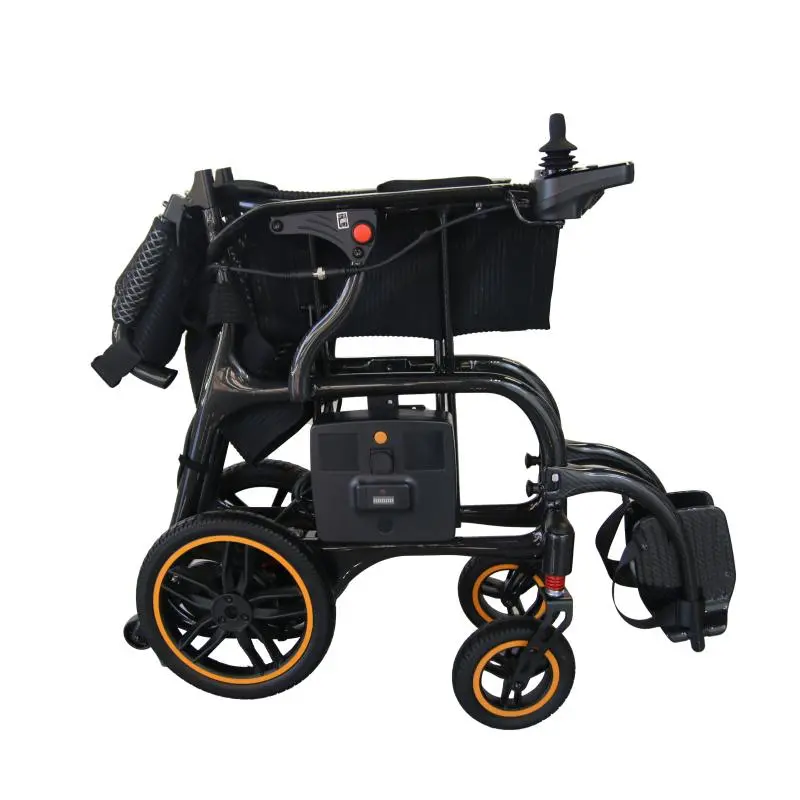
Will the carbon fiber material make the wheelchair too light, leading to tipping over?
No.
The lightweight nature of carbon fiber does not pose a risk of tipping over, for the following reasons:
1. Tipping over is related to "wheelbase" and "track width," not weight.
A wider track width and longer wheelbase maintain lateral stability.
The chassis structure design of carbon fiber power wheelchairs is exactly the same as traditional materials, so the stability is the same or even higher.
2. Lightweight design makes the vehicle easier to control and prevents skidding due to excessive inertia.
The heavier the vehicle:
• The greater the inertia
• The greater the swing amplitude
• The higher the risk of skidding
Carbon fiber electric wheelchairs are lightweight and have low inertia, making them less likely to experience serious skidding or tipping over.
3. High torsional strength prevents structural deformation during turns.
One major cause of tipping over is structural deformation leading to a shift in the center of gravity. Carbon fiber frames have extremely high torsional strength and will not deform during turning.
How does the anti-tip device on a carbon fiber power wheelchair specifically prevent tipping over?
Most carbon fiber power wheelchairs are equipped with:
1. Rear anti-tip wheels
Uses:
• Prevents tipping backward on inclines
• Prevents tipping backward during sudden acceleration
• Prevents tipping over when crossing obstacles
2. Anti-rollover structure
Includes:
• Wide wheelbase chassis
• Low center of gravity design
• Weight concentrated in the lower part of the vehicle body
3. Electronic stability control system
Includes:
• Downhill speed limit
• Acceleration buffering
• Cornering speed limit
• Emergency braking system
All these devices work together to ensure that carbon fiber electric wheelchairs do not tip over in various environments.
Is a carbon fiber power wheelchair safer due to its ultra-lightweight body?
Lightweight design does not equate to instability; on the contrary, it provides a safer experience in most scenarios.
1. Easier to maintain a stable sitting posture
Due to the lightweight body and low acceleration, the user's body will not suddenly tilt forward or sideways due to inertia.
2. Shorter braking distance
Lightweight design means faster braking.
Especially in emergencies, carbon fiber power wheelchairs can stop more quickly.
3. Batteries are concentrated at the bottom, resulting in a lower center of gravity
Batteries are usually placed in:
• The chassis layer
• Near the drive wheels
• At the center of the ground
This makes carbon fiber electric wheelchairs more "grounded" than some traditional wheelchairs, resulting in higher stability.
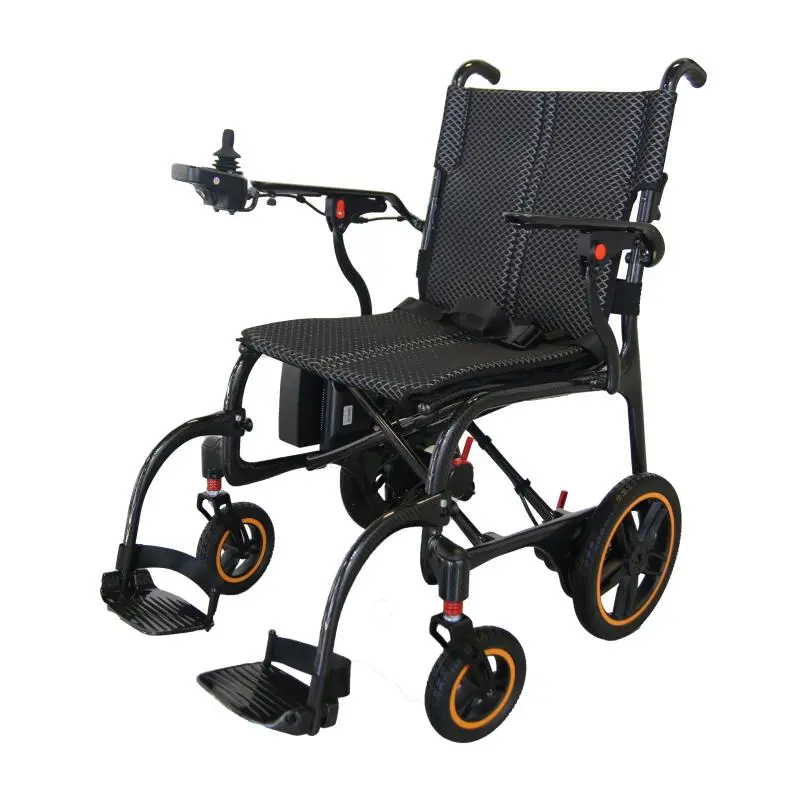
Does the lightweight design of carbon fiber power wheelchairs affect wind resistance?
No.
Wind resistance mainly affects high-speed vehicles.
The speed of carbon fiber power wheelchairs is usually:
• 4km/h to 6km/h
• Equivalent to walking speed
• Will not tilt or be significantly affected by wind
This speed is far from sufficient to cause a tipping risk due to wind.
Whether it's a gentle breeze or outdoor wind, the center of gravity of the carbon fiber power wheelchair will not be affected.
Is the center of gravity of a carbon fiber power wheelchair more stable than that of a regular electric wheelchair?
In many cases, carbon fiber electric wheelchairs are more stable than traditional electric wheelchairs.
The reasons are as follows:
• Higher frame rigidity
• More balanced weight distribution
• Easier to achieve lightweight design in the chassis
• Easier to achieve a low and concentrated center of gravity
• More advanced engineering design
Therefore, lightweight design does not affect stability; instead, it provides an optimized center of gravity structure.
Can manufacturers offer customization on carbon-fiber electric wheelchairs?
Manufacturers with in-house R&D and production capabilities can and often do provide customization on carbon-fiber electric wheelchairs to fit brand requirements and market regulations. Dayang Medical, a China-based manufacturer founded in 2009, offers OEM/ODM services such as custom colors, logo placement, accessory packages, and battery configuration (6AH or 10AH removable lithium options).
For purchasing managers and brands, customization helps position a product as a differentiated offering in retail, hospital procurement, or travel-focused sales channels.