

When choosing a walking frame, one of the most common questions is: which type of walking frame is the most stable? Stability directly affects the user's sense of security, confidence in walking, and rehabilitation effectiveness.
There are many types of walking frames on the market – wheeled walking frames, folding walking frames, four-legged canes, crutches, etc. Among all types, the non-wheeled walking frame (also known as a fixed walking frame) is generally considered the most stable.
This article will systematically answer the core question of "what is the most stable walking frame" from multiple perspectives, including structural principles, applicable users, usage methods, and stability principles, and will delve into why non-wheeled walking frames stand out in terms of safety and support.
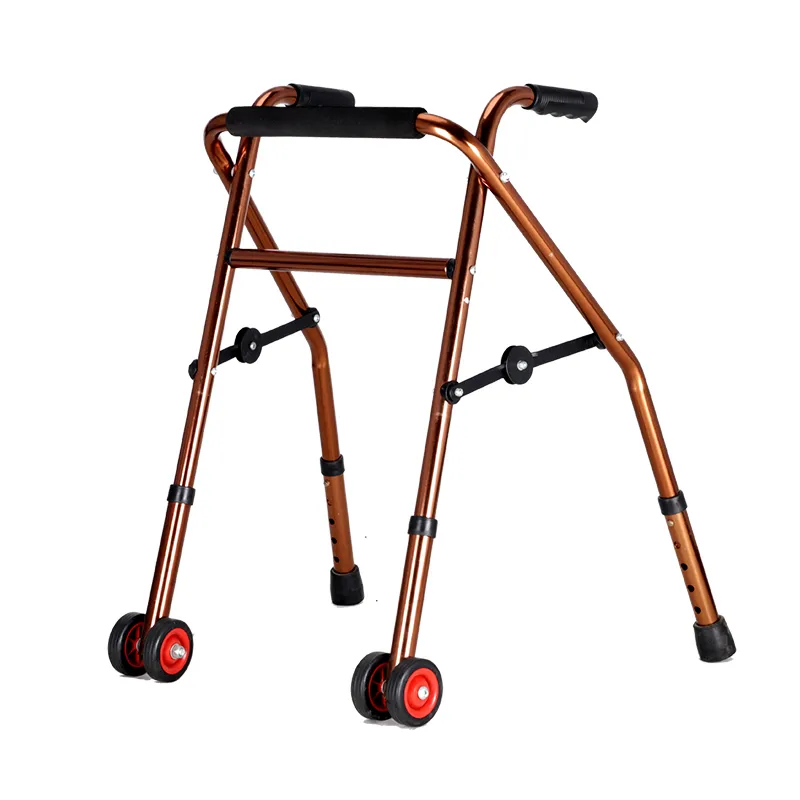
What is a non-wheeled walking frame?
A non-wheeled walking frame is a fixed walking aid without front or rear wheels. It is usually made of lightweight metal (such as aluminum alloy) and has four footpads supporting the ground. Users need to lift the walking frame, move it forward, and then put it down again to assist in walking. Each step is controlled by the user, and the walking frame will not slide or roll.
In contrast, wheeled walking frames have wheels on the front or both front and rear legs. While they are easier to push, they are prone to instability or sliding risks on slopes, slippery surfaces, or during the initial stages of standing up.
Therefore, from a physical structure perspective, the "non-sliding support" characteristic of the non-wheeled walking frame is the fundamental source of its stability.
Why is the non-wheeled walking frame considered the most stable?
1. Fixed structure with four points of contact
The four feet of the non-wheeled walking frame are in contact with the ground simultaneously. There are no wheels, so it will not slide or roll.
This "static support" ensures that the walking frame remains in a stable equilibrium state when the user is moving or standing.
Whether on hard floors, carpets, or slightly uneven surfaces, as long as the footpads are in full contact with the ground, the walking frame remains stable.
This structure is equivalent to providing the human body with a "four-legged stool" type of support. The center of gravity is stable, and there is no risk of tilting due to inertia or changes in friction.
2. Direct transfer of support force, reducing shaking
When a wheeled walking frame is pushed, the support force is transferred through the wheel axles and frame, which can easily cause slight shaking. In contrast, the wheel-less walking frame is different. The user's body weight is directly transferred through their hands to the walking frame, and then the pressure is distributed among the four fixed support points of the walking frame. The force transmission path is stable and direct.
This not only improves safety but also allows users to maintain better balance when getting up, standing, and turning.
3. No risk of "inertial sliding"
The presence of wheels means a reduced coefficient of friction, which often leads to a potential risk of sliding.
The wheel-less walking frame completely eliminates this problem – because there are no wheels, the walking frame only moves when the user actively lifts it, avoiding the possibility of accidental sliding.
This is especially important for those in the early stages of rehabilitation, those with weak lower limbs, or those with balance problems.
4. Stability over flexibility
Although the wheel-less walking frame is slightly less convenient and slower than a wheeled walking frame, it sacrifices flexibility for the highest level of safety and stability.
For users who are just starting rehabilitation, have unstable gait, or require high levels of support, this "stability-first" design is the most suitable choice.
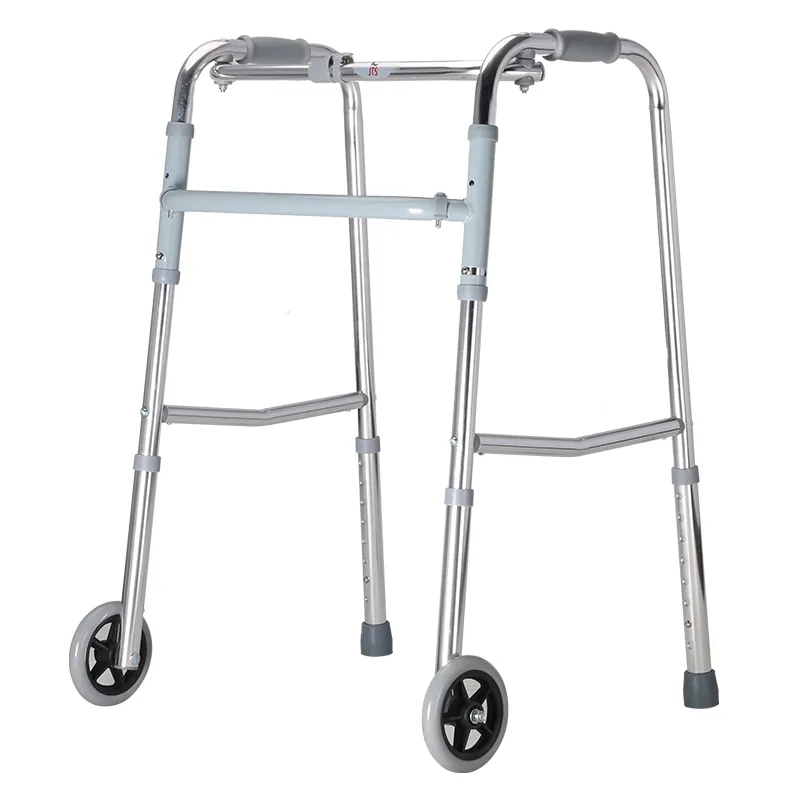
In what scenarios does the stability of the wheel-less walking frame manifest itself?
1. Stable support when getting up and sitting down
Many elderly people or rehabilitation patients are most likely to lose their balance when getting up from or sitting down on a chair.
The wheel-less walking frame provides the most stable support point during this stage. Users can hold the sides of the walking frame with both hands, steadily shifting their center of gravity, avoiding upper body swaying or forward tilting and loss of balance.
2. Stable center of gravity transfer during walking
When walking, the user needs to lift the walking frame, place it forward, and then move their body.
Although this process is done in stages, the walking frame remains stationary at each stage, providing a stable support point for the body at all times.
In contrast, a wheeled walking frame is in a "sliding" state during walking, and if the ground friction is uneven, slight deviations may occur.
3. Stability during turning and pausing
The turning of the wheel-less walking frame completely depends on the user lifting and repositioning it; there is no deviation caused by "wheel slippage."
When pausing or resting, it is completely stationary with all four feet on the ground, allowing the user to maintain a stable standing posture without worrying about movement.
Who is the wheel-less walking frame suitable for?
The wheel-less walking frame is designed to provide the most stable and secure support, making it suitable for the following groups:
• Individuals with weak lower limb muscles: especially the elderly, post-operative rehabilitation patients, and those with muscle atrophy or degenerative joint diseases.
• Individuals with poor balance: it requires less body coordination and provides a stable center of gravity.
• Rehabilitation patients beginning gait training: the wheel-less walking frame helps them relearn walking in a safe environment.
• Users on flat surfaces or indoors: indoor surfaces are generally flat, allowing the non-slip footpads of the wheel-less walking frame to provide stable support.
For individuals who need to move long distances outdoors or on uneven ground, a wheeled walking frame can be used in later stages of rehabilitation. However, in the initial training phase, the wheel-less walking frame remains the most stable option.
Why is the structure of the wheel-less walking frame more stable?
1. From a physical perspective: the relationship between static friction and the support surface
The wheel-less walking frame relies on the static friction between the footpads and the ground for support. A high coefficient of static friction prevents slipping.
The four support points are evenly distributed, placing the overall center of gravity at the center of the support surface, creating an optimal stable structure.
This is the key to its "table-like stability": low center of gravity, wide support base, and high friction.
2. From an ergonomic perspective: controllable center of gravity transfer
When using a wheeled walking frame, the user pushes it forward while their center of gravity shifts forward;
The wheel-less walking frame requires the user to move the walking frame first, and then move their body.
This "position first, then move" mode ensures that the center of gravity remains within the support surface, preventing forward tilting and instability.
Therefore, the wheel-less walking frame is more suitable for the safety needs of early rehabilitation from an ergonomic perspective.
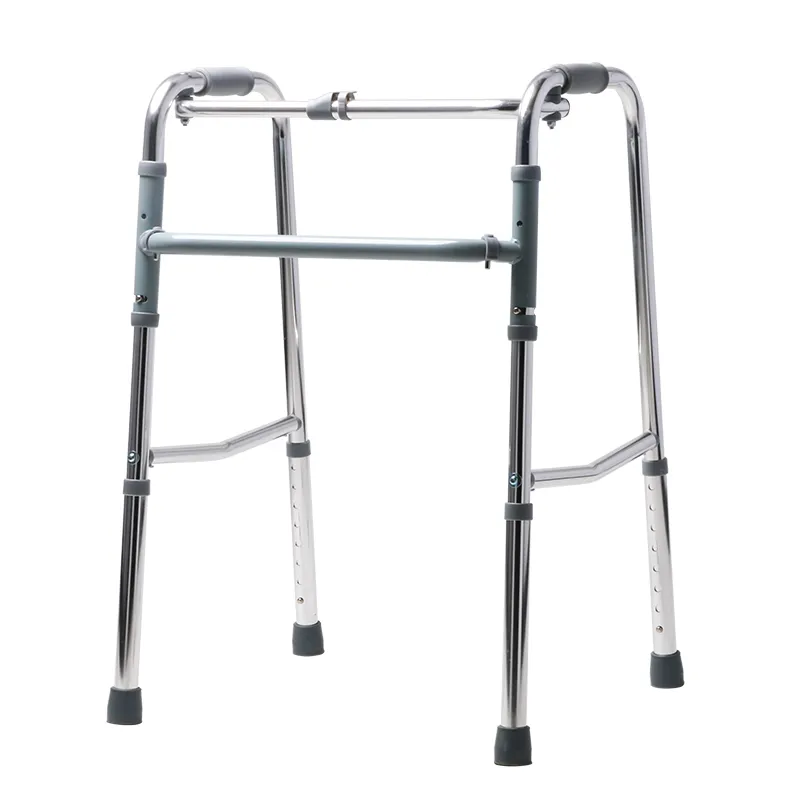
Why does the footpad design of the wheel-less walking frame affect stability?
The bottom footpads of the wheel-less walking frame are usually made of non-slip rubber.
High-quality footpads have the following characteristics:
• High coefficient of friction: prevents slipping on the ground;
• Shock absorption and pressure reduction: reduces the impact when placing the walking frame down;
• Balanced support: maintains stability when all four points are in contact with the ground.
When all four footpads are in full contact with the ground, the walking frame forms a "static equilibrium structure," providing maximum stability.
Therefore, when purchasing a wheel-less walking frame, attention should be paid to the material and structure of the footpads.
How to maintain optimal stability when using a non-wheeled walking frame?
1. Adjust to the appropriate height
The height of the walking frame should be level with the user's wrists (when standing upright with arms naturally hanging down).
Too high will cause shoulder tension, and too low will increase the risk of bending over.
2. Ensure all four legs are firmly on the ground
If the ground is uneven, adjust your posture or position to ensure that all four legs bear weight evenly.
3. Hold with both hands simultaneously
Do not use a non-wheeled walking frame with only one hand, otherwise it is easy to tilt or lose balance.
4. Step-by-step movement method
Before lifting the walking frame each time, ensure your body is completely stable; move your feet only after the frame is moved, avoiding simultaneous movement.
5. Keep your body upright
Avoid leaning forward excessively to prevent your center of gravity from exceeding the support surface.
Comparison of Stability Between Non-Wheeled and Wheeled Walking Frames
Feature Comparison | Wheelless Walking Frame | Wheeled Walking Frame |
| Stability | ★★★★★ | ★★★ |
Flexibility | ★★ | ★★★★★ |
| Safety (Anti-slip) | ★★★★★ | ★★★ |
| Effort Required | Large (requires lifting) | Less effort required (can be pushed) |
| Suitable Users | For early rehabilitation and those with weak balance | Suitable for later stages of rehabilitation and those with stable mobility |
| Ground Adaptability | Best for indoor use | Suitable for both indoor and outdoor use |
| Safety on Slopes/Downhills | Very high | Requires extra caution |
The comparison table clearly shows that non-wheeled walking frames far surpass wheeled walking frames in terms of stability and safety.
Although slightly less flexible, this is the price of its "stability," and also its advantage.
Is a non-wheeled walking frame safer?
The answer is yes.
In the field of medical rehabilitation and elderly care, safety and stability are often the primary considerations.
Because non-wheeled walking frames have no rolling parts, there is no risk of slipping. Even on wet or slippery surfaces, the friction of the footpads is sufficient to provide safe support.
This means that the stability of the walking frame is almost unaffected by external environmental factors under any circumstances.
This "predictable sense of security" is an important support in the psychological rehabilitation of many patients.
Key Points for Using a Non-Wheeled Walking Frame in Daily Life
Although we won't discuss specific cases, we can summarize its daily usage patterns:
• Best for short-distance walking indoors;
• Particularly suitable for high-risk periods such as getting up in the morning and going to the toilet at night;
• Works better when paired with non-slip mats and on level ground;
• It is recommended to regularly check the wear of the footpads to maintain maximum friction.
Why is "stability" more important than "speed"?
The design purpose of a walking frame is not to increase walking speed, but to safely assist walking.
Especially in the early stages of rehabilitation or among the elderly, speed is not the key; safe balance and stable support are fundamental.
The wheel-less walking frame achieves this goal with a simple structure:
No complex parts, no risk of sliding; every step is controlled, stable, and reliable.
This is precisely why it's called the "most stable walking frame."
Maintenance and Stability of the Wheel-less Walking Frame
To keep the wheel-less walking frame in optimal stable condition, the following maintenance points should be noted:
• Regularly check the wear of the footpads and replace them if necessary;
• Maintain the integrity of the walking frame structure, avoiding metal fatigue or deformation;
• Clean dust from the bottom of the footpads to prevent reduced friction;
• Store in a dry environment to prevent oxidation and corrosion.
These simple maintenance measures will allow the walking frame to maintain stable and safe support performance for a long time.
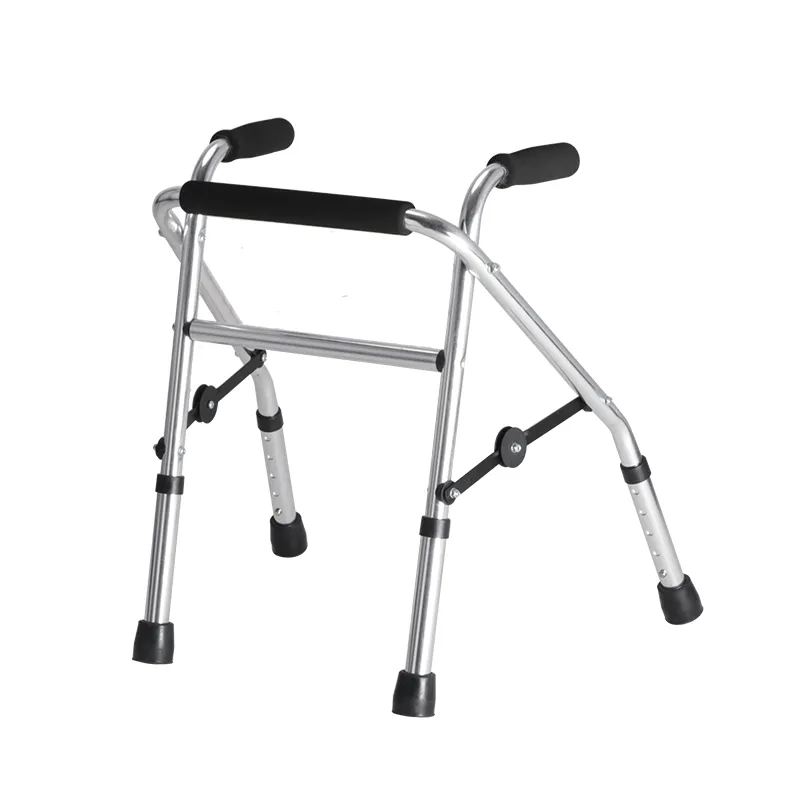
Are there any limitations to the wheel-less walking frame?
Although the wheel-less walking frame is the most stable, there are still some usage limitations to be aware of:
• Not suitable for long-distance outdoor use;
• Lifting and moving requires more effort;
• Not suitable for uneven ground or environments with many steps.
However, for use cases that prioritize the "highest level of safety," these drawbacks are completely acceptable.
Stability is always the primary criterion.
Why is the wheel-less walking frame the most stable walking frame?
The wheel-less walking frame is the most stable because:
• Fixed structure, four-point support, no risk of sliding;
• Even weight distribution, direct support force;
• Anti-slip footpads provide maximum friction;
• The user's center of gravity is always within the support surface, making it less likely to tip over.
From both a physical and ergonomic perspective, the wheel-less walking frame is an assistive device designed for stability.
For users who prioritize safety and support, it is the most trustworthy choice.
How flexible are Dayang Medical’s customization services?
Our customization services are highly flexible. We can modify wheelchair frames, bed dimensions, color schemes, packaging, and logos to meet client needs. Buyers who purchase directly from our China factory benefit from OEM services, wholesale pricing, and special promotions. Customization is available for small-batch or large-scale orders, ensuring each product aligns with the buyer’s brand identity.
By offering tailored solutions, Dayang Medical stands out as a trusted manufacturer and supplier for high quality, low cost medical equipment worldwide.