

As people age or experience a decline in physical function, many experience unsteady gait, difficulty walking, or weakened balance. Choosing a suitable walking aid becomes crucial.
Among the many assistive walking devices, four-wheel rollators and walking frames are the two most common types, providing varying degrees of support and balance stability.
However, different walking aids target different balance needs. This article will systematically analyze how people with poor balance should choose a walking aid based on their individual circumstances, the advantages and disadvantages of four-wheel rollators and walking frames, and safety precautions to take when using them.
Why do people with poor balance need to use a walking aid?
Poor balance typically means difficulty maintaining a stable center of gravity while stationary or walking. For the elderly, post-operative recovery patients, or those with neurological disorders, this instability can increase the risk of falls.
The purpose of walking aids is to support body weight through additional contact points, helping users maintain balance and safety while walking.
The support provided by walking aids is mainly reflected in three aspects:
• Weight distribution – reducing the load on the lower limbs through arm support;
• Stable support – increasing ground contact points and reducing the amplitude of center of gravity sway;
• Psychological safety – significantly increasing confidence while walking and reducing the fear of falling after using a walking aid.
For people with poor balance, the key to choosing a walking aid is:
Whether the support is stable enough, whether the structure is safe enough, and whether it is easy to operate.
What is a Four-wheel Rollator? Who is it suitable for with poor balance?
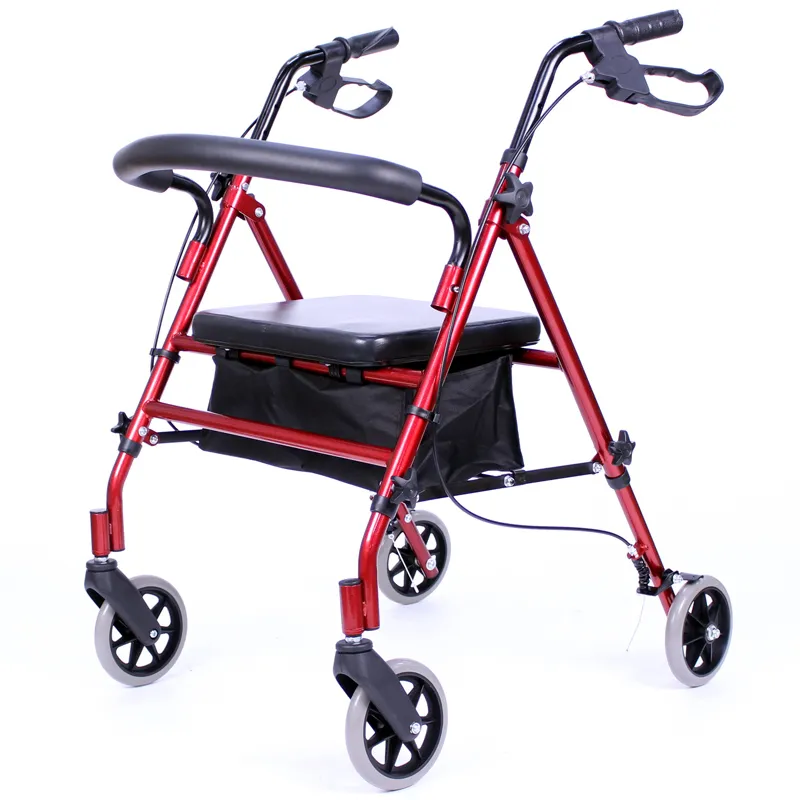
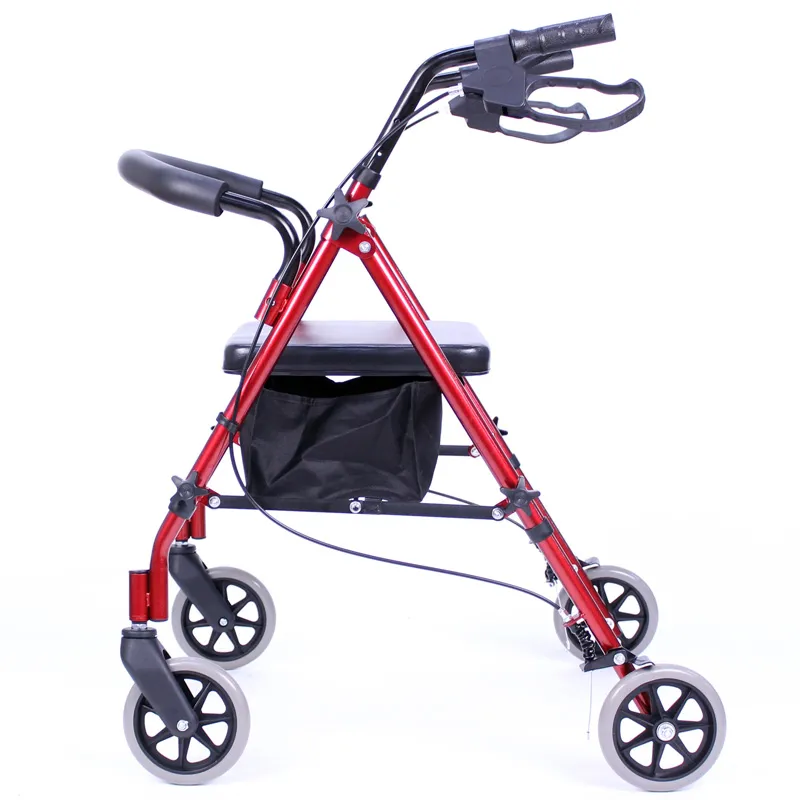
A four-wheel rollator is a walking aid with four support wheels, a handbrake, a seat, and armrests.
It is more flexible than a traditional walking frame, allowing users to maintain continuous support while walking and to sit down and rest directly when tired.
1. Structural features of a four-wheel rollator
• Four-wheel design: Four points of contact with the ground, making the device smoother to push on flat surfaces.
• Dual-hand brake system: Allows users to control speed and stop at any time while walking.
• Handrail support area: Allows users to distribute their body weight with their arms.
• Built-in seat and backrest: Allows users to sit down and rest immediately when tired, preventing exhaustion.
• Foldable structure: Convenient for outdoor carrying and storage.
2. Key advantages of a four-wheel rollator
• Smooth walking: The rollator design reduces friction, suitable for outdoor use or smooth surfaces;
• Assists with mild balance problems: Very friendly to those with decent lower limb strength but unstable gait;
• Provides psychological support: Holding the handrails helps enhance a sense of security;
• Braking device improves safety: Prevents the rollator from slipping and causing falls;
• Includes a seat for convenient rest.
3. Suitable Users of a Four-Wheel Rollator
A four-wheel rollator is suitable for the following groups:
• People with mild balance impairment but still possessing some leg strength;
• People who need slight support and a sense of security while walking;
• People who frequently engage in outdoor activities and need to walk long distances;
• Elderly people who need to rest and sit down to recover their energy.
In other words, a four-wheel rollator is suitable for people who can walk but are unsteady, as it provides "dynamic balance support" rather than complete static support.
What is a walking frame? Why is it more suitable for people with severe balance impairment?
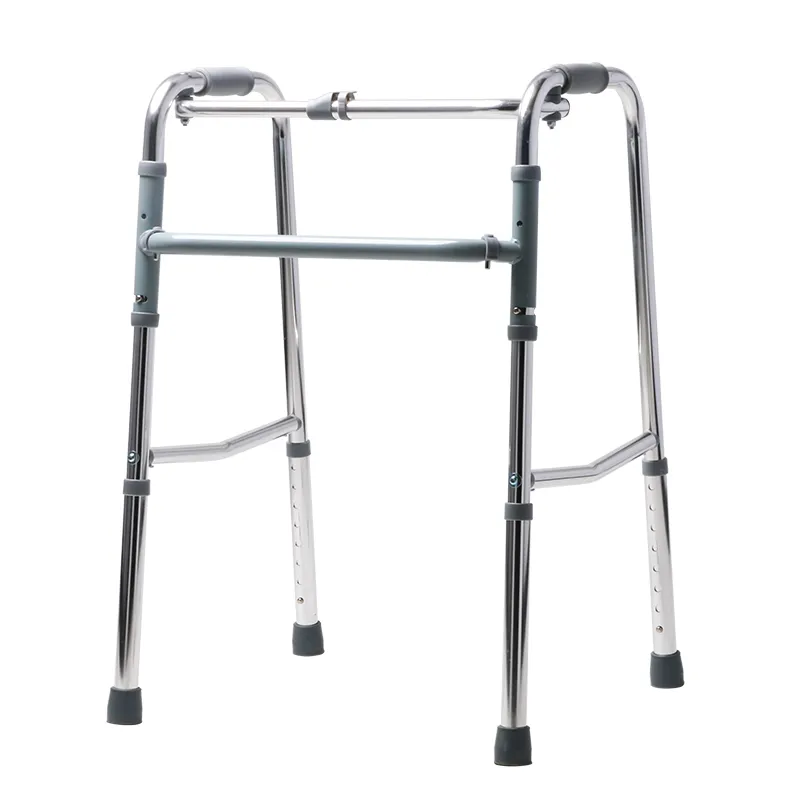
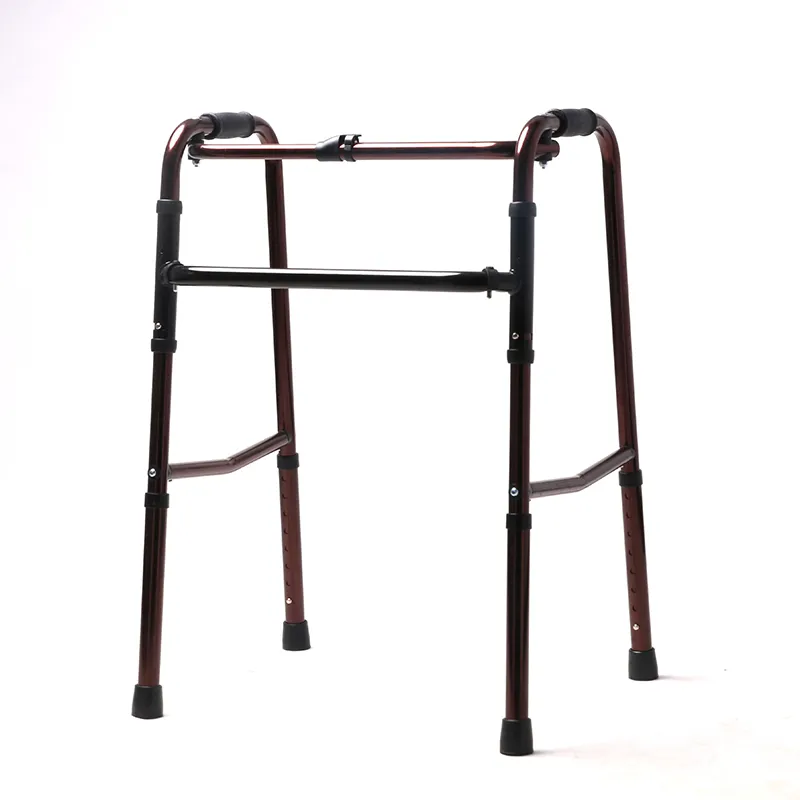
Compared to a four-wheel rollator, a walking frame (Walker) is a more stable walking aid. It has four or two fixed support points firmly in contact with the ground, and the user needs to lift or push the walking frame forward.
1. Types of Walking Frames
Walking frames are divided into two categories based on their base design:
• Wheelless walking frame: All four feet are non-slip pads; the user needs to lift it to move.
• Wheeled walking frame: The front wheels are movable, while the rear feet have non-slip rubber pads, reducing the difficulty of lifting.
2. Structural Advantages of Walking Frames
• Fixed contact points, preventing slippage;
• Strong support, capable of supporting greater weight;
• Wide support surface, high stability;
• Suitable for narrow indoor spaces, easy to operate.
3. Suitable Users of Walking Frames
Walking frames are more suitable for the following groups:
• Those with severely impaired balance and unable to walk independently;
• Post-operative rehabilitation, those with insufficient lower limb strength;
• Those who require greater support and need to rely on their upper limbs for movement;
• Those whose activities are primarily indoors and whose walking distances are relatively short.
Therefore, walking frames are an ideal choice for people with "severe balance disorders," providing the most stable support foundation.
What is the difference between a four-wheel rollator and a walking frame?
Although both four-wheel rollators and walking frames are walking aids, they differ significantly in structure, support methods, and target users.
In short:
• If you can still walk but have slightly poor balance, a four-wheel rollator is more suitable;
• If you are unsteady even when standing and need stable support, a walking frame is safer.
How should people with poor balance determine which walking aid is right for them?
To determine which walking aid is right for you, you can analyze it from the following five dimensions:
1. Your own balance ability
• If you are only slightly unsteady and can walk independently, choose a four-wheel rollator;
• If you cannot stand for long periods or often tilt and lose balance, choose a walking frame.
2. Upper limb strength
• A walking frame requires lifting or pushing with both hands. If your upper limb strength is insufficient, a four-wheel rollator is easier to operate.
3. Activity environment
• Outdoor roads are flat and spacious → a four-wheel rollator is recommended;
• Indoor walkways are narrow and have many turns → a walking frame is more suitable.
4. Purpose of Use
• For restoring confidence in walking and daily commuting → Choose a four-wheel rollator;
• For assisting in standing and short-distance movement → Choose a walking frame.
5. Safety Dependence
• A walking frame can fully support body weight, while a four-wheel rollator is more for "balance support" than "full weight-bearing."
What are the precautions for using a four-wheel rollator with poor balance?
Although the four-wheel rollator is easy to operate, people with poor balance still need to pay attention to safety when using it.
• Always lock the brakes before use – Before sitting down or standing up, be sure to lock the brakes to prevent slippage;
• Keep your body close to the center of the vehicle while walking – Avoid pushing too far, which can cause your center of gravity to shift forward;
• Turn slowly – especially on ramps, carpeted surfaces, etc.;
• Avoid going up and down stairs – a four-wheel rollator is not designed for overcoming obstacles;
• The handrail height should be appropriate – ideally, your arms should be bent naturally at about 15 degrees when standing.
These correct usage habits can significantly reduce the risk of falls, making the walking frame a true "safety support" rather than a potential hazard.
What safety points should be noted when using a walking frame?
While a walking frame is stable, incorrect operation can actually cause joint or shoulder strain.
Recommended usage:
• Ensure stable foot placement; avoid excessive forward leaning when moving the walking frame;
• Hold the frame with both hands in the middle to maintain lateral balance;
• Take small, slow steps to ensure stability with each movement;
• The ground should be non-slip and free of obstacles to prevent foot slippage or tipping.
For users with very poor balance, a wheeled walking frame can be chosen to reduce lifting movements while maintaining forward stability.
Which is safer, a four-wheeled rollator or a walking frame?
Safety depends on the user's balance and operating method.
In summary:
• The walking frame is safer and more stable, suitable for people who need full support;
• The four-wheel rollator is also very safe once the user masters the technique, suitable for people with mild instability who can still walk independently.
However, please note:
• The four-wheel rollator cannot be pushed or ridden like a wheelchair.
• Always hold onto the handlebars with both hands and keep your center of gravity within the roll's interior area.
Can Dayang Medical provide medical equipment for home care?
Yes. Guangdong Dayang Medical Technology Co., Ltd. offers medical devices suitable for home care, including manual and electric wheelchairs, sports wheelchairs, hospital beds, shower chairs, commodes, walking aids, and canes. Founded in 2009, we are a professional manufacturer and supplier with two R&D and production bases in China.
Dayang Medical is a trusted supplier for healthcare providers, distributors, and medical brands worldwide.