

Against the backdrop of an aging population and the continuous advancement of rehabilitation medicine, various mobility aids have become essential tools for improving the quality of life for the elderly, post-operative patients, and individuals with mobility impairments. Among these, the quad walking stick—characterized by high stability, versatility, and excellent safety—has become a common mobility aid in hospitals, rehabilitation centers, elderly care facilities, and home care settings. Unlike standard single-point canes, quad walking sticks make contact with the ground via four support points, offering a larger base of support and superior balance; consequently, they are favored by many users with compromised balance.
However, consumers often have questions when purchasing one: "Is the quad walking stick the most stable option?" "Is it suitable for all elderly people?" "How does it differ from standard canes or walkers?" In reality, while quad walking sticks offer high stability, they are not suitable for everyone, nor are they the best choice for every situation. Selecting a mobility aid requires a comprehensive assessment of the user's physical condition, muscle strength, balance, stage of rehabilitation, and daily environment.
Global research on aging and falls indicates that approximately one-third of adults over the age of 65 experience at least one fall annually, making falls a leading cause of fractures, disability, and hospitalization among the elderly. Proper use of mobility aids—including quad walking sticks—can enhance walking stability, reduce the risk of falls, and boost confidence in mobility. Therefore, understanding the characteristics, advantages, and appropriate applications of quad walking sticks is crucial for making an informed choice and ensuring safe usage.
So, what exactly is a quad walking stick? Why is it more stable than a standard cane? Is it truly the most stable mobility aid available? This article provides a comprehensive analysis of these questions.
What is a quad walking stick?
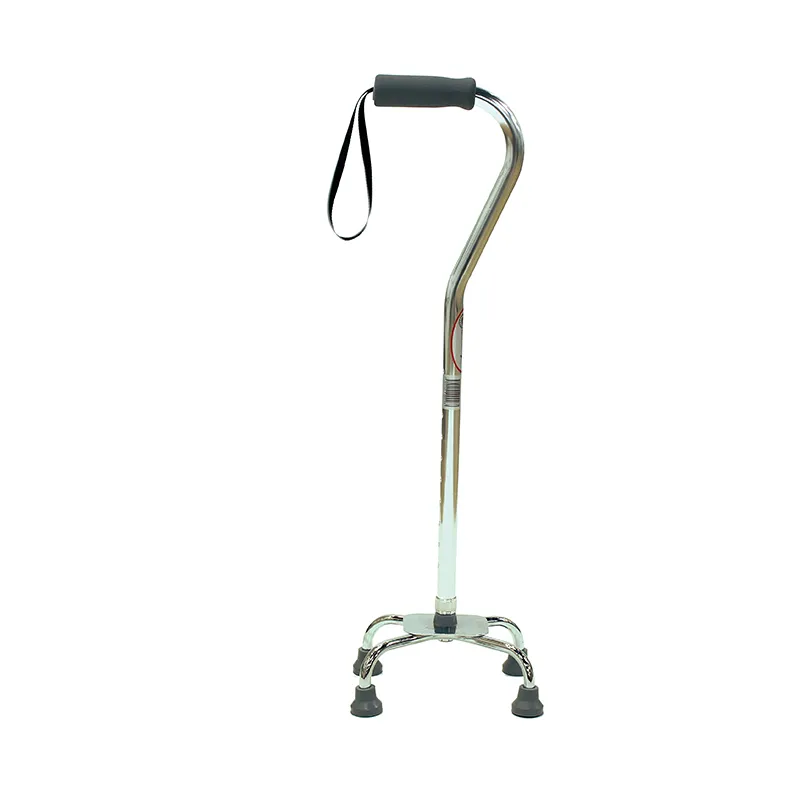
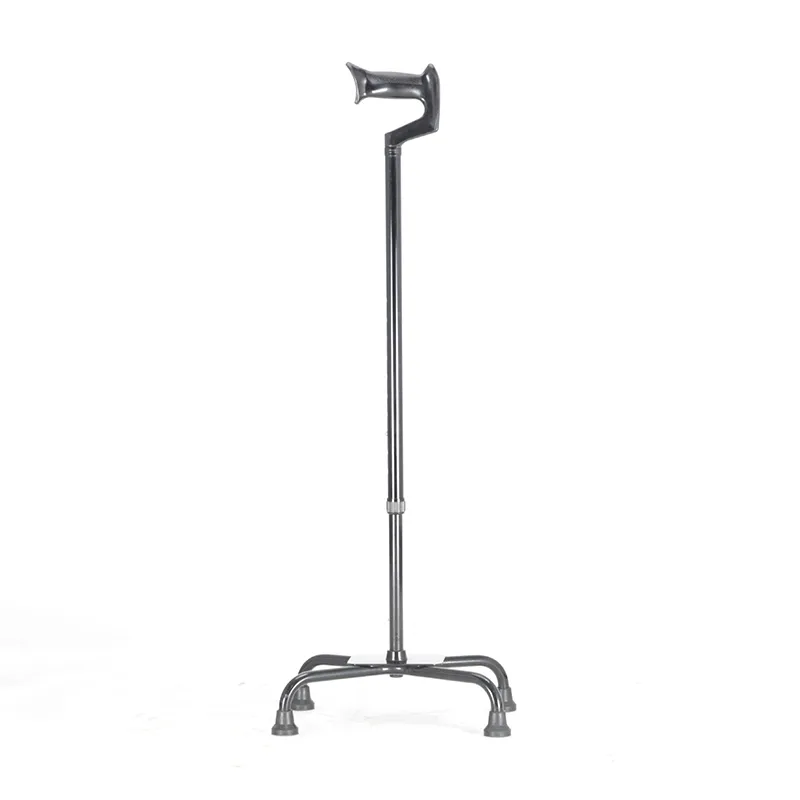
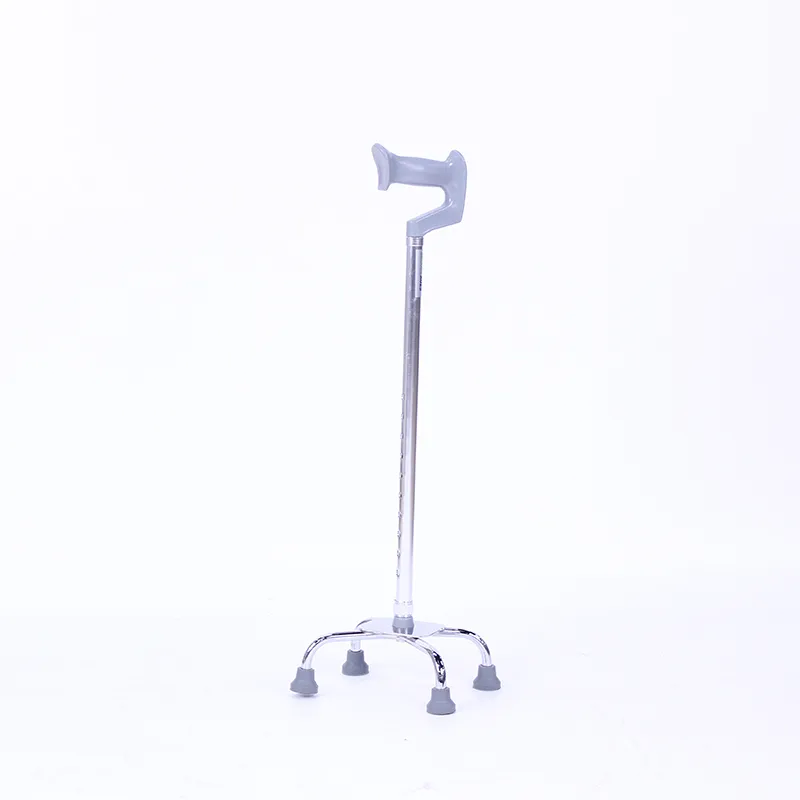
A quad walking stick is a mobility aid featuring a base with four supporting legs. Compared to traditional single-point canes, its defining characteristic is a four-point contact structure; by increasing the surface area in contact with the ground, it provides greater overall stability. A standard four-legged cane typically consists of a handle, a vertical shaft, a height-adjustment mechanism, a four-legged base, and anti-slip rubber tips. The four supporting feet at the base are usually arranged in a rectangular or trapezoidal pattern, providing stable support from multiple directions; even if the user momentarily relaxes their grip or shifts their weight, the cane tends to remain upright rather than toppling over like a conventional single-point cane.
Most four-legged canes on the market are made from aluminum alloy, high-strength steel, or lightweight alloys, balancing load-bearing capacity with a minimized overall weight. Many models also feature adjustable height settings to accommodate users of different statures.
Because they offer a balance of stability and portability, four-legged canes are widely used for stroke rehabilitation, post-orthopedic surgery recovery, and mobility assistance for individuals with neurological disorders or the elderly.
Why are four-legged canes more stable than standard canes?
The superior stability of four-legged canes stems primarily from their unique four-point support structure.
A standard single-point cane has only one contact point; when the user's center of gravity shifts, they must constantly adjust the cane's position to maintain balance. In contrast, the four support points of a four-legged cane create a broad base of support even when stationary, significantly enhancing resistance to tipping over.
From a mechanical perspective, a larger support area increases the likelihood that the user's center of gravity remains within the support footprint, thereby enhancing stability. By expanding the base's support area, the four-legged cane improves resistance to tipping in both lateral (side-to-side) and longitudinal (front-to-back) directions.
Additionally, the base is usually equipped with four anti-slip rubber tips. These not only increase friction but also provide excellent grip on various surfaces—such as tile, wood flooring, and concrete—further enhancing walking safety.
For individuals with reduced muscle strength, unsteady gait, or mild balance issues, four-legged canes provide reliable support with every step, making them a common assistive device in rehabilitation training.
Are four-legged canes the most stable mobility aid?
Many people assume that because a quad cane (four-legged cane) has four points of contact, it must be the most stable of all mobility aids. In reality, this view is not entirely accurate.
While a quad cane is indeed more stable than a standard single-point cane, its stability relative to other devices—such as walkers (frames), non-wheeled walkers, or wheeled walkers—depends on the specific context.
For instance, non-wheeled walkers typically provide a wide, four-point base of support and require the use of both hands, resulting in greater overall stability than a quad cane. Conversely, while four-wheeled walkers allow for easier movement, their rolling mechanism means their static stability differs from that of a quad cane; they are better suited for individuals who already possess some walking ability.
Therefore, while the quad cane offers high stability among cane-style products, it cannot simply be deemed the most stable choice among all mobility aids.
The choice of assistive device should be based on the patient's specific rehabilitation stage and medical condition, rather than a singular focus on maximizing the support base area.
Who is the quad cane suitable for?
Quad canes are suitable for individuals who require extra support but retain some ability to walk independently.
For stroke patients with hemiplegia—who often experience weakness in the affected lower limb and impaired balance—a quad cane provides more stable support, helping to improve gait and enhance safety during rehabilitation exercises.
For patients recovering from hip or knee replacement surgery, a quad cane helps distribute weight and reduce the load on the lower limbs, thereby improving stability during early postoperative walking.
For patients with Parkinson's disease—particularly in the early to mid-stages—a quad cane can assist with balance and reduce the risk of falls caused by mild gait instability.
Additionally, elderly individuals experiencing reduced muscle strength, osteoporosis, or mild balance issues may use a quad cane—upon the advice of a physician or rehabilitation therapist—to improve safety while walking.
However, for individuals unable to stand independently, those with severe balance impairments, or those requiring bilateral support, a quad cane alone may not ensure safety; in such cases, walkers, wheelchairs, or other assistive devices are typically required.
What are the advantages of a quad cane?
The widespread popularity of four-legged canes is closely linked to their various advantages.
First, they offer a larger base of support than standard canes, providing superior stability whether the user is stationary or walking; this makes them particularly suitable for early-stage rehabilitation training.
Second, most four-legged canes are self-standing—meaning they do not need to be propped against a wall—which is highly convenient for elderly individuals with limited mobility and eliminates the risk of bending down to retrieve a fallen cane.
Additionally, they are relatively lightweight; most aluminum alloy models weigh only about 0.8 to 1.2 kilograms, making them easy to carry and use.
Many models also feature adjustable height settings, allowing for customization based on the user's stature. This promotes a more ergonomic grip, helping to reduce strain on the shoulders and wrists.
For those requiring long-term mobility aids, four-legged canes offer the benefits of easy maintenance, reasonable pricing, and versatility across various settings, leading to their widespread adoption in home care and community rehabilitation.
What are the limitations of four-legged canes?
While they offer excellent stability, they are not without drawbacks.
Due to their large base, they may lack the agility of standard single-point canes when navigating stairs, narrow passageways, or uneven terrain.
Furthermore, the four-legged base can be easily obstructed by obstacles such as door thresholds, stones, or the edges of steps, requiring extra caution in complex environments.
For individuals who walk quickly or have a high level of mobility, a four-legged cane may restrict their natural gait and feel less flexible to use than a standard cane.
Consequently, they are best suited for users who prioritize stability over speed and may not be the ideal choice for everyone.
How do you choose the right four-legged cane?
When selecting a four-legged cane, consider the user's height, weight, medical condition, and typical usage environment.
First, opt for a model with adjustable height. The correct height is generally determined when the user stands naturally with arms relaxed; the handle should align with the wrist crease, allowing the elbow to maintain a slight bend of approximately 15° to 30°.
Second, pay attention to the size of the base. Quad canes with small bases offer greater maneuverability and are suitable for indoor use, while those with large bases provide superior stability, making them better suited for individuals with poor balance.
It is also important to check the durability of the non-slip rubber tips, the ergonomic design of the handle, and the cane's overall weight-bearing capacity. Generally, mainstream models support between 100 kg and 150 kg; the specific model should be chosen based on individual needs.
For frequent outdoor use, consider a quad cane made of lightweight aluminum alloy featuring rust-resistant finishes and durable rubber tips to enhance both longevity and comfort.
FAQ
What is the difference between a quad cane and a standard cane?
Quad canes feature a four-point support structure that offers a larger base of support. They generally provide greater stability than standard single-point canes, making them ideal for individuals with impaired balance.
Is a quad cane the most stable mobility aid available?
While quad canes offer high stability among cane-style aids, they may not be the most stable option when compared to devices like non-wheeled walkers; the choice should depend on specific needs.
Who is a quad cane suitable for?
Quad canes are generally suitable for stroke patients with hemiplegia, individuals recovering from joint replacement surgery, patients in the early to mid-stages of Parkinson's disease, the elderly, and those with mild to moderate balance impairments.
Can a quad cane be used on stairs?
Yes, but due to the larger base, users must pay close attention to foot placement and support positioning. If the stairs are narrow or the user has limited mobility, using the cane with the assistance of a caregiver is recommended.
How do I adjust the height of a quad cane?
Generally, the handle should be adjusted to align with the wrist crease, allowing the elbow to maintain a natural bend of approximately 15° to 30°. This position optimizes support while minimizing shoulder and wrist fatigue.
Does a quad cane require regular maintenance?
Yes. Regularly inspect the non-slip rubber tips for wear, check that adjustment holes are secure and the shaft is not loose, and keep the cane clean and dry to ensure safe and stable long-term use.