

In modern nursing environments, the Patient Lift Transfer Chair has become an essential piece of equipment to assist people with mobility impairments in daily activities such as sitting up, transferring, and toileting.
Traditional manual or hydraulic transfer chairs, while capable of raising, lowering, and moving, require significant physical effort to operate and necessitate manual control during raising and lowering, leading to staff fatigue.
With technological advancements, a more efficient and user-friendly product has emerged—the remote-controlled electric transfer chair.
Through an electric drive system and wireless remote control technology, it allows caregivers to easily perform raising, lowering, and moving operations.
Therefore, when discussing the question, "Is the Patient Lift Transfer Chair easy to operate?", we are essentially comparing the user experience differences between traditional mechanical and remote-controlled electric transfer chairs.
Ease of operation depends on three key factors:
• Is the operation simple and easy to learn?
• Is the device responsive and stable?
• Is it safe and reliable during use?
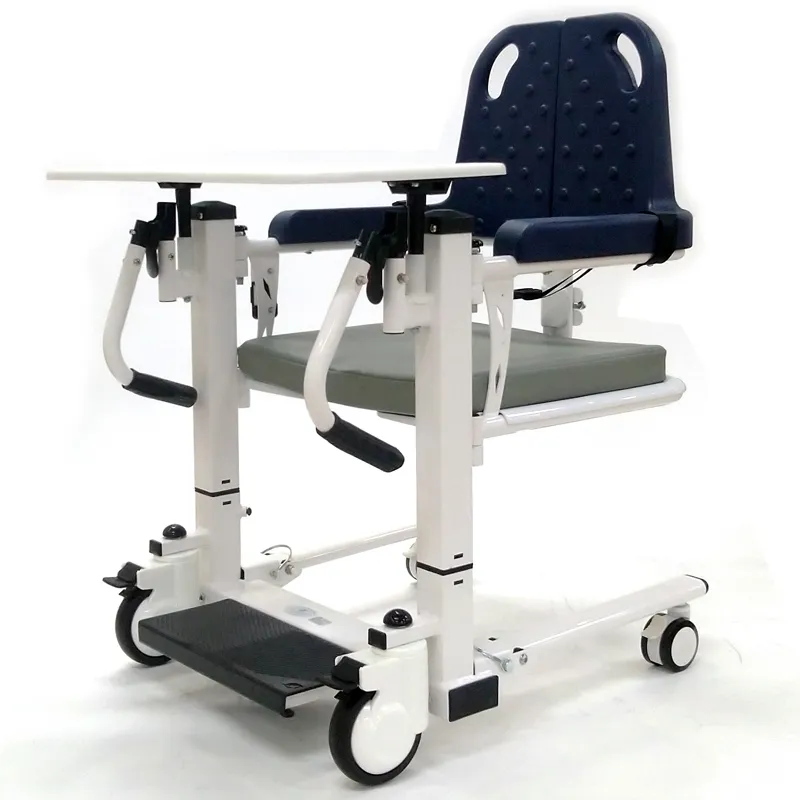
What is a remote-controlled electric transfer chair?
A remote-controlled electric transfer chair is a nursing device that uses an electric lifting system and a wireless remote control module. It can perform lifting, moving, and turning movements without requiring manual operation of the hydraulic rods.
It typically consists of the following parts:
• Electric actuator system: used for lifting;
• Wireless remote control module: enables remote operation;
• Battery system: provides power to the entire machine;
• Main support structure: supports the patient's body;
• Safety belt and braking system: ensures safe use;
• Swivel casters with anti-slip design: facilitates turning and moving.
Remote-Controlled Electric Transfer Chair VS. Traditional Hydraulic Lifting Transfer Chair
Comparison Items | Remote-controlled electric transfer chair | Hydraulic lifting transfer chair |
| Operating Method | Remote or button control | Manual hydraulic lever control |
| Effort Consumption | Extremely small, requiring almost no physical effort | Requires repeated manual operation |
| Lifting Stability | Electric push-rod control, smooth and even operation | Relies on hydraulic control, limited precision |
| Usage Scenarios | Suitable for homes, hospitals, and nursing homes | Commonly used in medical institutions |
| Cost | Slightly tall | Relatively low cost |
From an operational perspective, the remote-controlled electric transfer chair is significantly more maneuverable than the traditional hydraulic type, making it particularly suitable for elderly or physically limited caregivers.
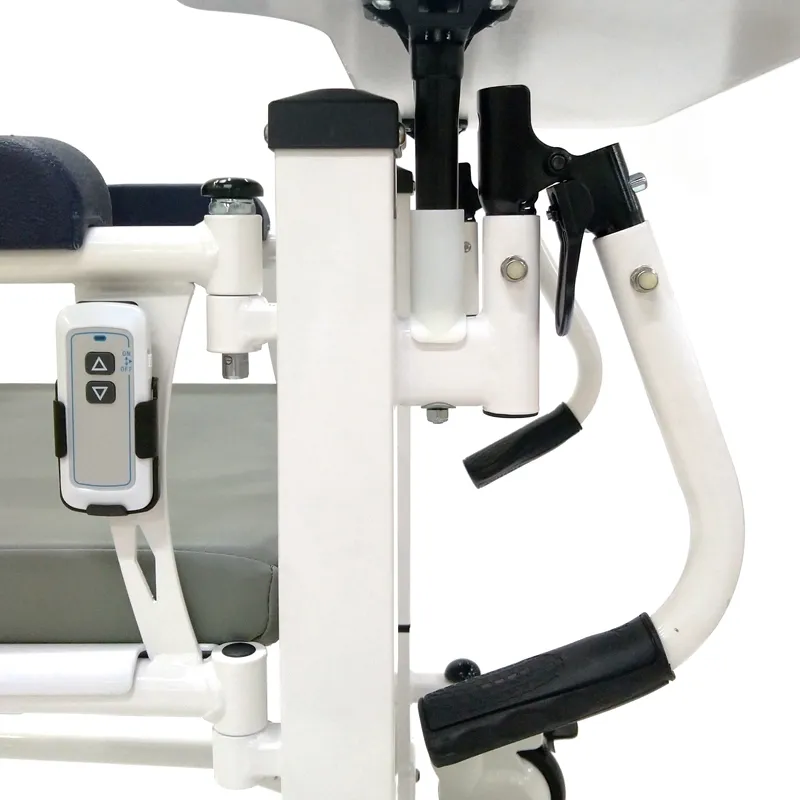
What are the control methods for a remote-controlled electric transfer chair?
1. Remote Control Operation
Most remote-controlled electric transfer chairs are equipped with a wireless remote control featuring multiple independent function buttons:
• Raise button
• Lower button
• Forward and backward control
• Brake or locking function
• Battery level indicator and warning light
Caregivers can operate the chair from a safe distance (generally 1-3 meters) without bending over or pushing.
2. Manual Backup Button
To prevent remote control malfunction or low battery, the chair usually has a manual control panel on the armrest or rear, allowing direct button operation for raising, lowering, and locking.
3. Electric Drive and Safety Lock Interlock
When remote-controlled raising or lowering is initiated, the system automatically triggers the bottom locking device to prevent the chair from sliding during raising or lowering, enhancing safety.
In summary:
The operating logic of a remote-controlled electric transfer chair is "button operation, automatic interlocking, and safety assurance."
How convenient is it to operate a remote-controlled electric transfer chair?
1. Simple Operation, Almost Zero Learning Cost
The remote-controlled electric transfer chair uses a one-button operation mode, allowing even users without medical experience to quickly master its use.
The operation process is very intuitive:
• Turn on the power;
• Confirm brake status;
• Use the remote control to control the height adjustment;
• Release the lock and move for transfer.
The entire process requires no bending over, exerting force, or manual angle adjustment.
2. Smooth Lifting and Lowering, Safer Operation
Traditional hydraulic systems require manual control of the lifting speed, while the remote-controlled electric transfer chair's motor drive speed is fixed, resulting in smooth descent.
This constant speed control avoids discomfort caused by sudden descent for the patient.
3. Can be Operated by One Person, Reducing Caregiver Burden
The remote-controlled electric transfer chair allows a single person to complete the entire transfer process.
The caregiver only needs to control the lifting and direction via remote control, eliminating the need for two people to support the patient.
This is especially important for home care, as it can greatly reduce the intensity of care.
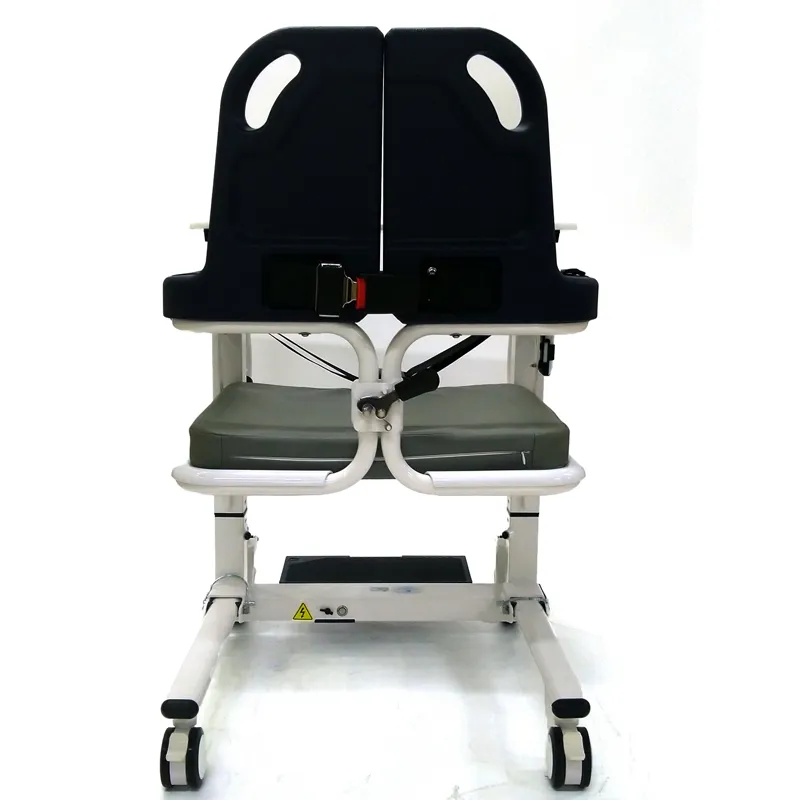
Is the remote control system of the remote-controlled electric transfer chair reliable?
1. Stable Wireless Connection Technology
Mainstream remote-controlled electric transfer chairs utilize 2.4GHz wireless signals or Bluetooth connections, offering strong anti-interference capabilities.
Even in a hospital environment with multiple devices in use simultaneously, stable response is maintained.
2. Reasonable Control Distance
The remote control distance is generally controlled between 1 and 3 meters, ensuring both convenient operation and real-time monitoring by the operator within the patient's line of sight.
3. Intelligent Battery Management
The remote-controlled electric transfer chair is equipped with a battery monitoring system that issues an alarm when the battery is low, preventing operation interruption due to power failure during lifting and lowering.
What safety features are included in the remote-controlled electric transfer chair?
While ease of operation is paramount, safety remains a core design consideration for remote-controlled electric transfer chairs.
1. Anti-slip and Anti-tipping Structure
The chair chassis features a low center of gravity structure and wide wheel spacing, ensuring no tilting during lifting and lowering.
2. Electric Soft-Descent System
When the "Descent" button is pressed, the motor slowly releases thrust, ensuring a smooth and abrupt descent.
3. Automatic Braking and Electronic Locking
During the lifting and lowering process, the remote-controlled electric transfer chair automatically triggers the brake lock to prevent the chair from sliding.
4. Multiple Safety Protection Circuits
Including short-circuit protection, overload protection, and overcurrent protection. Even in case of accidental operation, the motor and circuitry will not be damaged.
What are the suitable usage scenarios for the remote-controlled electric transfer chair?
1. Hospital Care
During ward transfers, the remote-controlled electric transfer chair can quickly adjust height and direction, reducing the workload for nurses.
2. Home Care
For those caring for elderly parents or post-operative patients, it can help a single person transfer between beds and toilets safely and effortlessly.
3. Nursing Homes
The remote control function allows caregivers to complete the transfer of multiple elderly people within a limited time, improving efficiency.
4. Rehabilitation Training Area
The height adjustment function can be used in conjunction with rehabilitation training to help patients gradually regain their sitting ability.
What are the core components of the electric control system of a remote-controlled electric transfer chair?
1. Electric Push Rod (Height Adjustment Motor)
This is the key component for achieving the height adjustment function. It is usually driven by a high-precision DC motor, with a lifting stroke of approximately 20–40 cm.
2. Control Circuit Board
Responsible for receiving remote control signals and controlling current output to ensure synchronized and smooth movements.
3. Wireless Receiver Module
Pairs with the remote control to achieve signal transmission.
4. Battery System
Most use 12V or 24V lithium batteries, providing 5–8 hours of continuous use.
5. Mechanical Support and Linkage System
Converts the electric thrust into vertical lifting motion, ensuring structural stability.
These core components work together to make the remote-controlled electric transfer chair responsive and reliable.
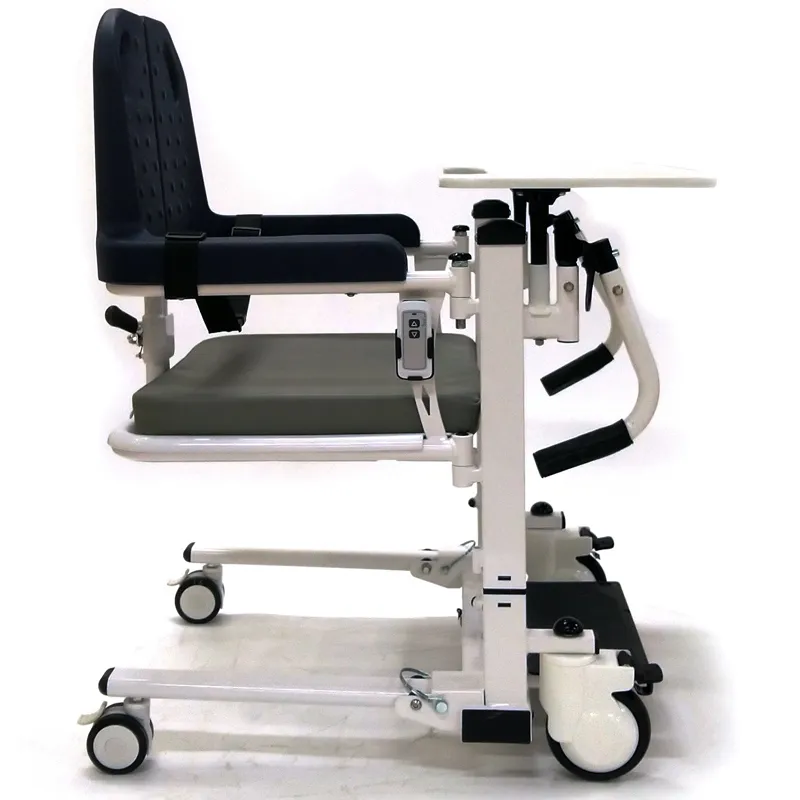
What precautions should be taken when using a remote-controlled electric transfer chair?
1. Check battery level before use
Ensure the battery is fully charged to avoid power outages affecting lifting and lowering operations.
2. Confirm brake activation before operation
All lifting and lowering operations should be performed after locking the brake to prevent the device from sliding.
3. Maintain eye contact during remote control
The operator should always monitor the patient's condition and not leave the operating area.
4. Do not use the lifting function on slopes
Lifting and lowering should be performed on level ground to prevent the device from tilting and unevenly distributing force.
5. Regular maintenance
Check the motor operation and wiring connections every 3 months to prevent loosening or aging.
Operating Experience of the Remote-Controlled Electric Transfer Chair
The remote-controlled electric transfer chair is very easy to operate and suitable for daily use in various nursing environments.
Its advantages are mainly reflected in:
• Simple operation – one-button lifting and remote control;
• Smooth lifting – stable operation of the electric push rod system;
• Safety protection – equipped with automatic locking and anti-tipping design;
• Labor saving – one person can easily complete the transfer;
• Convenient maintenance – replaceable battery and stable control system.
For patients requiring long-term care or elderly caregivers, the remote-controlled electric transfer chair not only makes operation easier but also makes the transfer process safer and more comfortable.
How does Dayang invest in innovation and product development?
Dayang invests in continuous R&D and product development across its two research and production bases, focusing especially on electric mobility solutions and high-end personalized designs. Our engineering team works on improving battery systems, motor control, ergonomic frames, and lightweight materials to deliver safer, more comfortable mobility devices. As a recognized national high-tech enterprise with multiple patents, Dayang can offer innovative features to partners seeking to purchase cutting-edge products or co-develop new models.