

When choosing a wheelchair, besides appearance, comfort, and materials, a frequently overlooked yet crucial question is: The size of the wheelchair's wheels—is it easier to push a wheelchair with large wheels or small wheels?
Different wheel diameters directly determine how the wheelchair is used, its driving performance, and the difficulty of pushing it.
For caregivers, wheel size not only affects the ease of pushing but also steering flexibility, safety, and suitability for different usage scenarios.
This article will analyze this from four dimensions: structural mechanics, frictional resistance, handling characteristics, and environmental adaptability, to provide you with a scientific answer to: Is it easier to push a wheelchair with large wheels or small wheels?
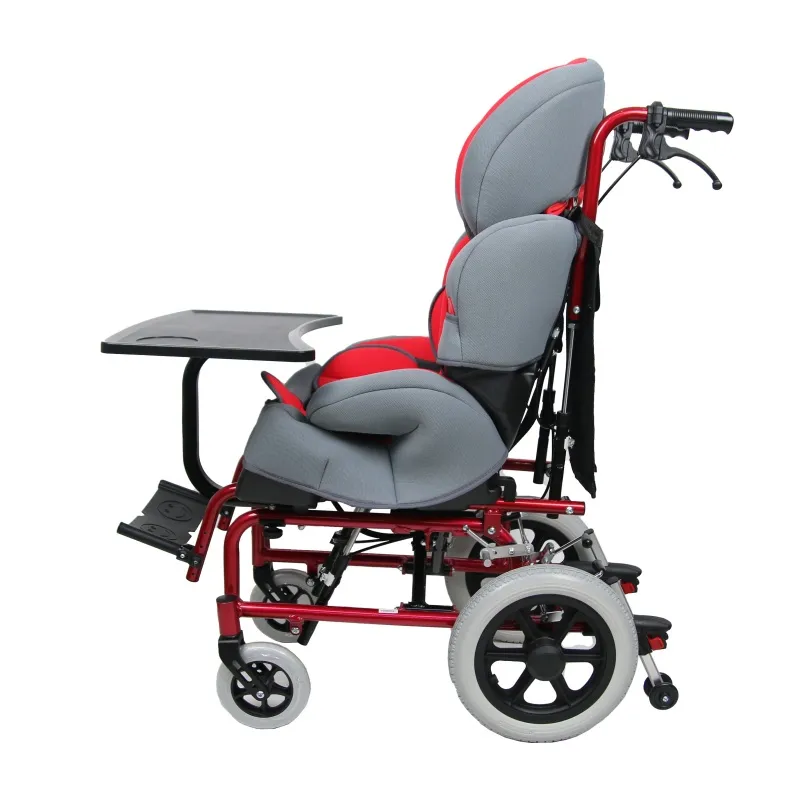
Why does wheel size determine the difficulty of pushing a wheelchair?
Many people believe that as long as a wheelchair has bearings and tires, it's all the same how it's pushed.
But in fact, wheel diameter is the primary factor affecting the wheelchair's pushing performance.
1. Wheel Diameter Affects Friction and Rolling Resistance
Mechanically, larger wheels result in lower rolling resistance, making it easier to maintain forward momentum.
Smaller wheels, with their smaller contact area and higher rotation frequency, are more prone to friction and jerking on flat surfaces.
This means:
• Larger wheelchairs are easier to glide over long distances or on uneven surfaces;
• Smaller wheelchairs are easier to control and turn in flat, confined spaces.
2. Wheel Diameter Determines Pushing Angle and Lever Arm Relationship
When a caregiver pushes a wheelchair, the pushing force is transmitted to the rear wheels through the handle.
Larger wheel diameters result in a longer lever arm, requiring less angle change during pushing, making arm movement more natural and effortless.
However, larger wheels also have a higher structure, raising the overall center of gravity, reducing maneuverability, and increasing the turning radius.
Therefore, whether a wheelchair is "easier to push" depends on the environment and intended use.
Why do some people find larger wheelchairs easier to push?
1. Larger wheels reduce rolling resistance
When pushing a wheelchair on flat ground, resistance primarily comes from friction and uneven surfaces.
Larger wheels have a larger radius, easily navigating small obstacles (such as thresholds or carpet edges) without frequent jamming.
This makes pushing smoother and easier for caregivers.
2. Larger wheels improve maneuverability
For those needing to use the wheelchair on outdoor surfaces, brick floors, or ramps, wheelchairs with larger wheels perform better.
Their structure absorbs minor vibrations, resulting in a more stable ride.
This is why manual wheelchairs with larger rear wheels are often used in hospital corridors, outdoor passageways, or places requiring long-distance pushing.
3. Larger wheels have higher inertia, making continuous pushing less strenuous
Physics tells us that once an object gains initial velocity, larger wheels, due to their greater moment of inertia, can maintain rolling motion for a longer period.
This means the pusher only needs to exert a little force at the start and can maintain movement relatively easily afterwards.
Therefore, wheelchairs with larger wheels are more energy-efficient and less strenuous for long straight distances.
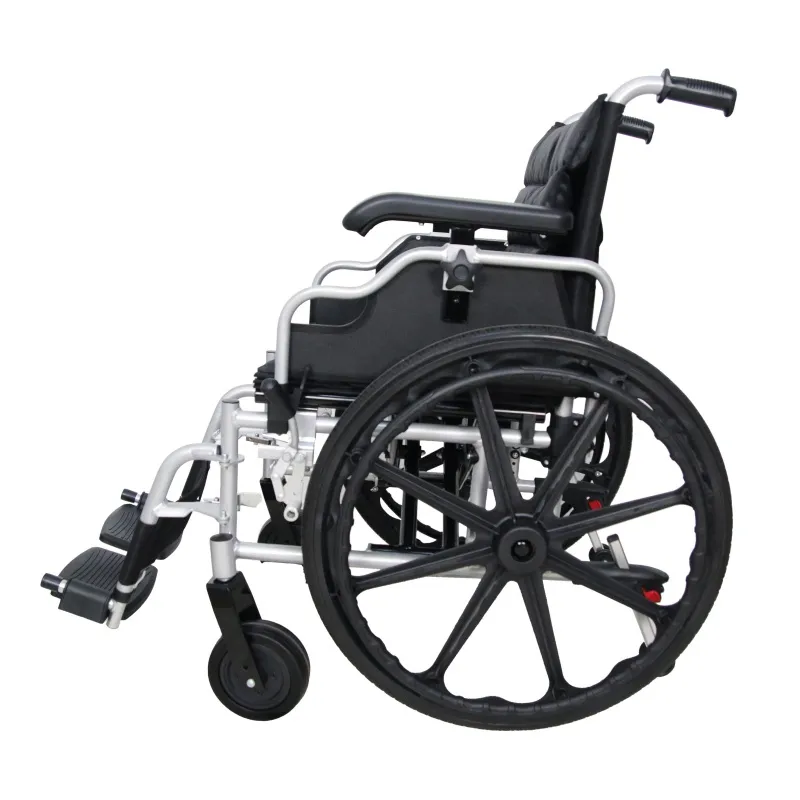
Why are small-wheeled wheelchairs easier to maneuver?
While large wheels offer advantages in stability, small-wheeled wheelchairs are actually more maneuverable in confined spaces or for short distances.
1. Small wheels are compact and more agile
Small-wheeled wheelchairs have a lower center of gravity and a smaller turning radius.
In confined spaces such as indoors, corridors, elevators, or hospital rooms, caregivers can more easily and precisely control the direction.
This principle is particularly evident in the lifting and transfer chairs commonly used in the medical care field.
These wheelchairs have smaller, more compact rear wheels, making pushing and turning easier and more flexible, ideal for nursing procedures.
2. Smaller wheels are lighter and easier to lift and store
Smaller wheels mean a lighter overall frame, less inertia when pushing, and faster start-up response.
For caregivers or family members with limited physical strength, small-wheeled wheelchairs significantly reduce the burden.
3. Higher control precision
Small wheels provide sensitive motion feedback, allowing the pusher to more precisely control distance and angle when making minor adjustments to direction or approaching confined areas such as bedsides or bathrooms, avoiding collisions.
In what environments is it easier to push a large-wheeled wheelchair?
1. Outdoor Surfaces or Slopes
Large wheels effectively handle uneven terrain, reducing bumps and jolting.
Whether on cobblestone streets, lawns, uphill, or slopes, wheelchairs with large wheels offer less resistance and greater maneuverability.
2. Long-Distance Pushing
If caregivers need to push wheelchairs long distances in corridors, community roads, or hospital grounds, the strong rolling inertia of large wheels maintains stability during continuous movement, making pushing easier.
3. User-Propelled Scenarios
When users have upper limb strength and can propel themselves using the handrails, the design of large wheels is more kinetic, making pushing easier.
Conclusion: Large-wheeled wheelchairs are more suitable for outdoor, long-distance, self-propelled, or obstacle-crossing scenarios.
In what environments are small-wheeled wheelchairs easier to push?
1. Indoor Spaces or Healthcare Facilities
In confined spaces (such as elevators, bedrooms, bathrooms, etc.), the compact structure of small-wheeled wheelchairs allows caregivers to easily turn, lean against walls, or enter narrow doorways.
This is one reason why lift-up transfer chairs are widely used—their smaller rear wheels and lower center of gravity make them more flexible to push and stop.
2. Frequent Turns or Short-Distance Movements
Nursing assistance often involves short distances and frequent movements, such as from the bedside to the bathroom or from the ward to the elevator.
In these situations, the lightness and agility of small-wheeled wheelchairs are clearly advantageous.
3. When Caregivers Have Limited Physical Strength
Small-wheeled wheelchairs are lighter and have less initial resistance when pushed, making them especially suitable for caregivers who are smaller or have limited physical strength.
Conclusion: Small-wheeled wheelchairs are more suitable for indoor environments with short distances and frequent turns, making them an ideal choice for nursing assistance.
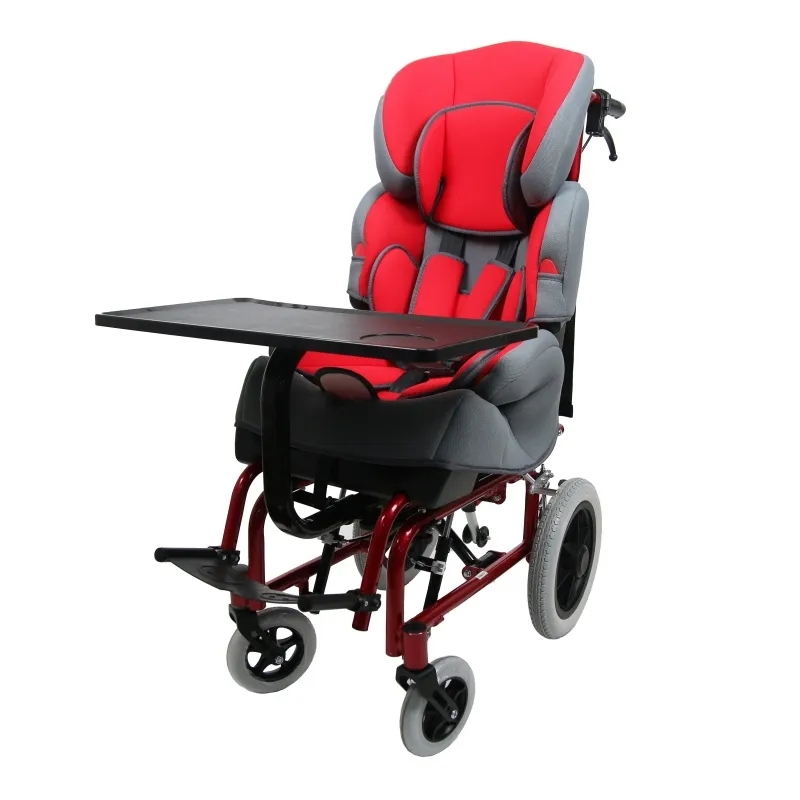
From an ergonomic perspective, which wheelchair requires less effort?
Pushing a wheelchair is not just a matter of strength, but also involves ergonomics and force transmission efficiency.
1. Pushing Large Wheels: Less Effort but Requires Space
Due to the larger wheel diameter, the pushing force is nearly horizontal, conforming to the natural angle of arm exertion.
However, large-wheeled wheelchairs are higher, requiring caregivers to slightly raise their arms or reach out, which can easily cause shoulder fatigue during prolonged pushing.
2. Small-wheeled wheelchairs: Comfortable to operate but require more control
Small-wheeled wheelchairs have a moderate pushing height, allowing caregivers to maintain a natural and relaxed posture.
However, due to slightly higher frictional resistance, more frequent control of direction and speed is required.
Overall:
• For long pushing distances, large wheels require less effort;
• For frequent operation, small wheels are more comfortable.
Large wheels require less effort, small wheels are more maneuverable—ease of pushing depends on the scenario
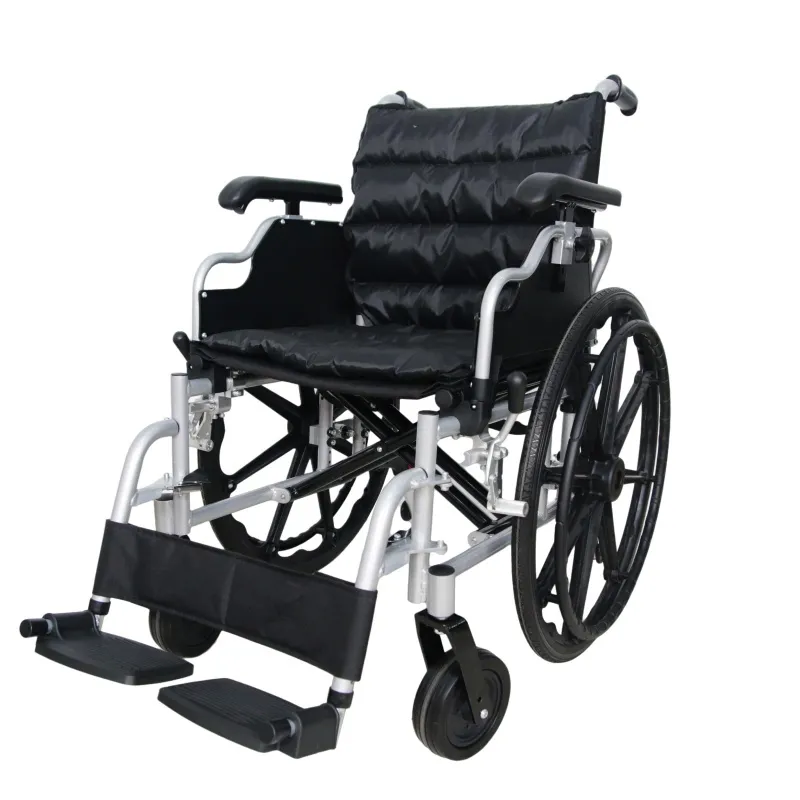
Is it easier to push a large-wheeled wheelchair or a small-wheeled wheelchair?
The answer depends on the usage scenario and the purpose of pushing.
Large-wheeled wheelchairs:
• Advantages: Smooth pushing, strong obstacle crossing ability, less effort over long distances;
• Disadvantages: Large size, large turning radius, less maneuverable in confined spaces.
Small-wheeled wheelchairs (such as adjustable transfer chairs):
• Advantages: Easy to handle, flexible to push, and effortless to steer;
• Disadvantages: Less maneuverable, not suitable for bumpy roads or long distances.
Therefore:
Large wheels are easier for staff to push and perform better on bumpy roads;
Small wheels are easier to maneuver, especially suitable for short-distance indoor care.
When purchasing, it is recommended to consider the user's physical condition, the environment in which the wheelchair is pushed, and the care needs, taking into account the wheel diameter.
Only by matching the correct wheelchair type can you truly achieve "easy pushing and safe sitting."
Can distributors purchase medical equipment directly from Dayang Medical factory?
Yes. Guangdong Dayang Medical Technology Co., Ltd. allows distributors to buy medical devices directly from our factory in China. Established in 2009, we are a professional manufacturer and supplier of electric wheelchairs, manual wheelchairs, sports wheelchairs, hospital beds, shower chairs, commodes, walking aids, and canes. Our two R&D and production bases ensure high-quality production and compliance with ISO13485, ISO9001, FDA, TUV, and CE standards.