

In routine care, toilet transfer is widely considered one of the riskiest and most challenging aspects of nursing care.
Compared to transferring a patient from bed to wheelchair or from room to living room, transferring a patient to the toilet often involves:
• Confined space
• Slippery floors
• Frequent changes in posture
• Patient privacy and dignity
For individuals with limited mobility, without appropriate assistive devices, toilet transfer is not only dangerous but also places a significant physical and psychological burden on caregivers.
Therefore, the patient transfer chair has become a crucial tool for solving the problem of "how to safely transfer a patient to the toilet."
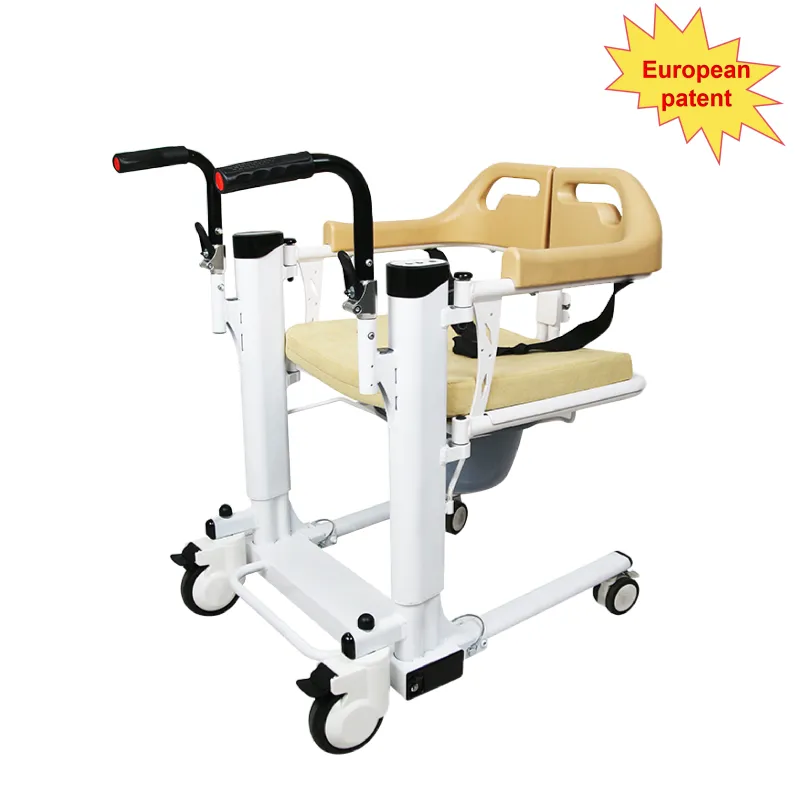
Why is transferring a patient to the toilet so difficult?
Before understanding the role of the patient transfer chair, it's essential to clarify: Why is toilet transfer more difficult than other transfers?
The main reasons include:
• Limited toilet space, making movement difficult.
• The patient needs to change positions from sitting to standing.
• Potential water on the floor, increasing the risk of slipping.
• The transfer process requires greater stability and precision.
If relying solely on manual assistance or a regular wheelchair, the following problems are likely to occur:
• Excessive force by caregivers.
• Patient instability.
• Slipping during the transfer.
This is precisely why patient transfer chairs are widely used in toilet transfer scenarios.
What role does a patient transfer chair play in toilet transfers?
The core value of a patient transfer chair lies in "safely completing the transfer," not simply moving the patient.
In toilet scenarios, a patient transfer chair primarily performs the following tasks:
• Assisting the patient from the bed or sofa to a chair.
• Safely pushing the patient to the toilet.
• Assisting the patient in sitting down or aligning with the toilet.
• Reducing the need for caregivers to lift or bend over.
With a patient transfer chair, the patient remains in a stable, supported position throughout the process, significantly reducing the risk of accidents.
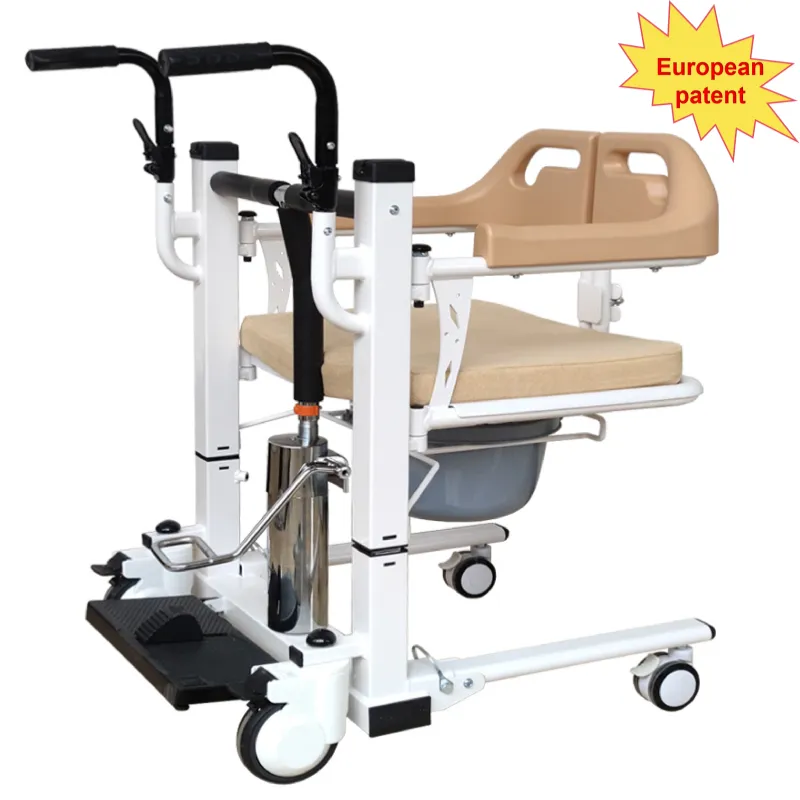
How to use a patient transfer chair to transfer a patient to the toilet?
While different models of patient transfer chairs may differ slightly in structure, the basic logic remains the same.
The toilet transfer process typically involves the following key steps:
Step 1: Safely seat the patient in the patient transfer chair
Patient transfer chairs can typically:
• Adjust the seat height
• Position themselves closer to the bed
• Expand or flatten the transfer surface
These designs allow the patient to safely sit in the patient transfer chair without being lifted; they only need to perform a short lateral movement or be assisted to stand.
Step 2: Push the patient transfer chair into the toilet
Once the patient is seated, caregivers can:
• Lock the brakes
• Adjust the armrests and footrests
• Slowly push the patient transfer chair.
Compared to a regular wheelchair, a patient transfer chair is more stable during movement and suitable for short indoor trips.
Step 3: Assist the patient into a toilet position
This is the most crucial and also the riskiest step.
Patient transfer chairs typically offer the following advantages:
• Height adjustable, flush with the toilet seat
• Removable or flip-up seat
• Easy alignment with the toilet
These structural designs allow patients to sit down in a very short time while suspended in the air, significantly improving safety.
Is it always necessary to transfer the patient to the toilet?
This is a very important but often overlooked question.
In fact, not all toilet needs require entering the bathroom.
👉 Some upright patient transfer chairs have a built-in toilet function, eliminating the need to move to the bathroom.
What are the advantages of a patient transfer chair with a built-in toilet?
Patient transfer chairs with a built-in toilet offer significant advantages in toilet care:
• No need to enter a cramped bathroom
• Reduced pushing and transfers
• Avoids the risk of slippery floors
• Improved safety during nighttime toilet visits
For patients with very limited mobility or frequent nighttime toilet visits, this type of patient transfer chair can significantly reduce the difficulty of care.
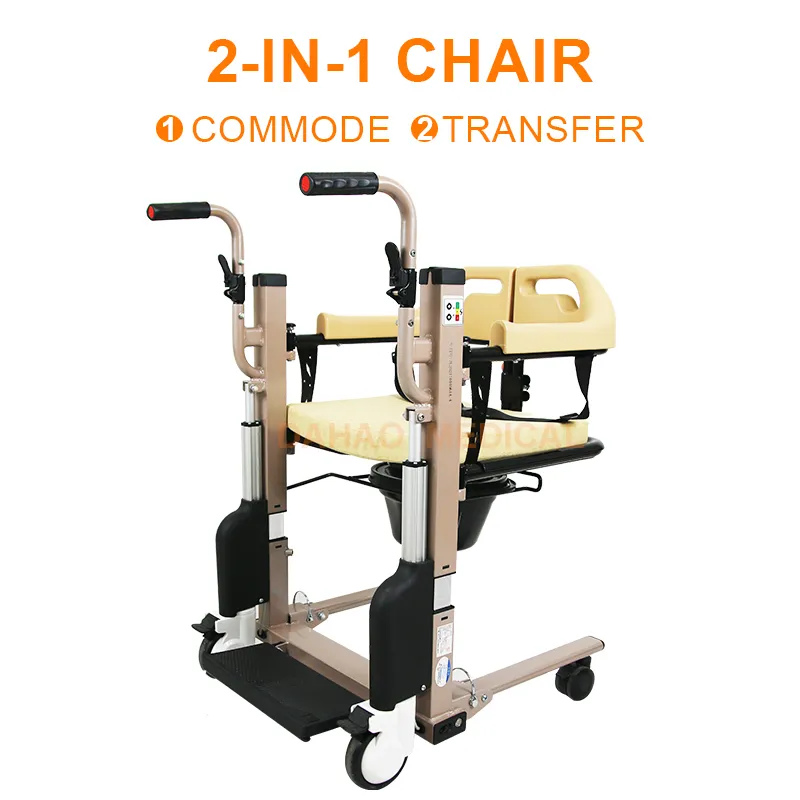
What is the difference between a patient transfer chair and a regular wheelchair in toilet transfers?
This is an area where many people easily get confused.
Limitations of Standard Wheelchairs
Standard wheelchairs typically have the following limitations:
• Fixed seat height
• Inability to get close to the toilet
• Seat cannot be unfolded
• Requires repositioning during toilet use
In toilet use scenarios, standard wheelchairs often only allow the patient to be "taken to the door," unable to complete crucial movements.
Targeted Design of Patient Transfer Chairs
Patient transfer chairs are specifically designed for transfer scenarios:
• Emphasis on height adjustment
• Greater focus on fit and stability
• More suitable for short-distance, multiple transfers
Therefore, patient transfer chairs are clearly more suitable for "how to transfer a patient to the toilet."
What safety details should be considered when using a patient transfer chair for toilet use?
To ensure safety during toilet transfers, pay special attention to the following:
• Lock the brakes before transfer
• Ensure the patient's sitting posture is centered
• Adjust the seat height to match the toilet
• Ensure the footrests and armrests do not obstruct movement
• Maintain slow and stable operation throughout
These details, though small, directly relate to the safety of the transfer.
Is a patient transfer chair suitable for all patients?
A patient transfer chair is not a "one-size-fits-all" device; it is more suitable for the following groups:
• People who can sit briefly or adjust their posture.
• Patients who do not require full suspension and elevation.
• People who need frequent toilet transfers.
For patients who are completely unable to sit, it is usually necessary to use it in conjunction with other transfer devices.
Why is a patient transfer chair particularly important in home care, especially in toilet situations?
In a home environment, toilet transfers often lack:
• Professional caregivers
• Spacious, accessible space
• Fixed handrails and non-slip features
In this environment, a patient transfer chair can:
• Significantly reduce the physical exertion of caregivers
• Improve the controllability of transfer movements
• Reduce the patient's psychological fear
Therefore, a patient transfer chair has very practical value in home toilet care.
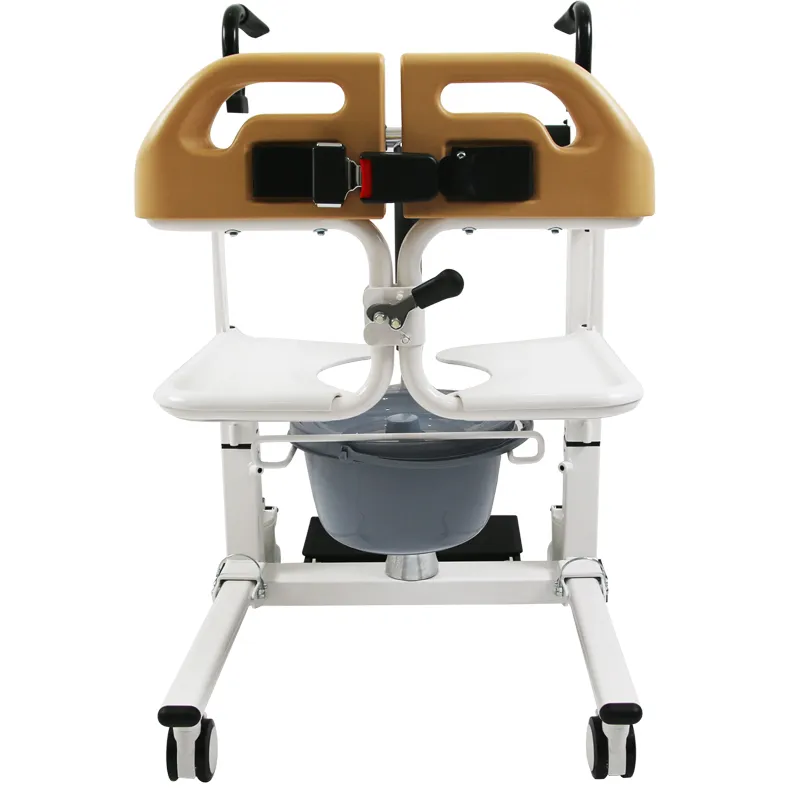
What are the differences between a patient transfer chair and a patient transfer machine in toilet transfers?
In short:
• Patient transfer machine: Lifts the patient using slings.
• Patient transfer chair: Transfers the patient while seated.
In situations with limited toilet space, a patient transfer chair is often more flexible;
While a transfer machine is safer when the patient is completely unable to cooperate.
What toilet-related features should you consider when choosing a patient transfer chair?
If primarily used for toilet transfers, focus on:
• Height adjustment
• Proximity to the toilet bowl
• Toilet bowl or bedpan available
• Easy cleaning
• Simple and stable operation
These features directly determine the practicality of the patient transfer chair in toilet settings.
How to transfer a patient to the toilet?
A patient transfer chair is a key tool.
👉 In the high-risk nursing process of toilet transfers, the patient transfer chair is a crucial and highly targeted assistive device.
It helps caregivers safely complete the task of "transferring the patient to the toilet" by:
• Providing a stable seated position
• Reducing lifting and carrying movements
• Optimizing height and space matching
Meanwhile, for some individuals, a patient transfer chair with a built-in toilet can completely replace the need to enter the restroom, further reducing risks.
In toilet care, choosing a suitable patient transfer chair not only ensures patient safety but also protects the health of caregivers.