

In a modern hospital system, the Intensive Care Unit (ICU) is one of the most critical medical units. It is responsible for treating critically ill patients and providing life support and continuous monitoring. Whether in a general hospital or a specialized hospital, the number and configuration of ICU hospital beds directly determine the level of critical care capacity.
So, the question arises: how many beds should an ICU have?
This is an extremely important issue in hospital construction, departmental planning, and medical equipment configuration.
This article will delve into the rational number standards for ICU bed configuration from the perspectives of functional positioning, space standards, staffing ratios, bed calculation basis, and scientific planning principles, helping readers better understand this core medical indicator.
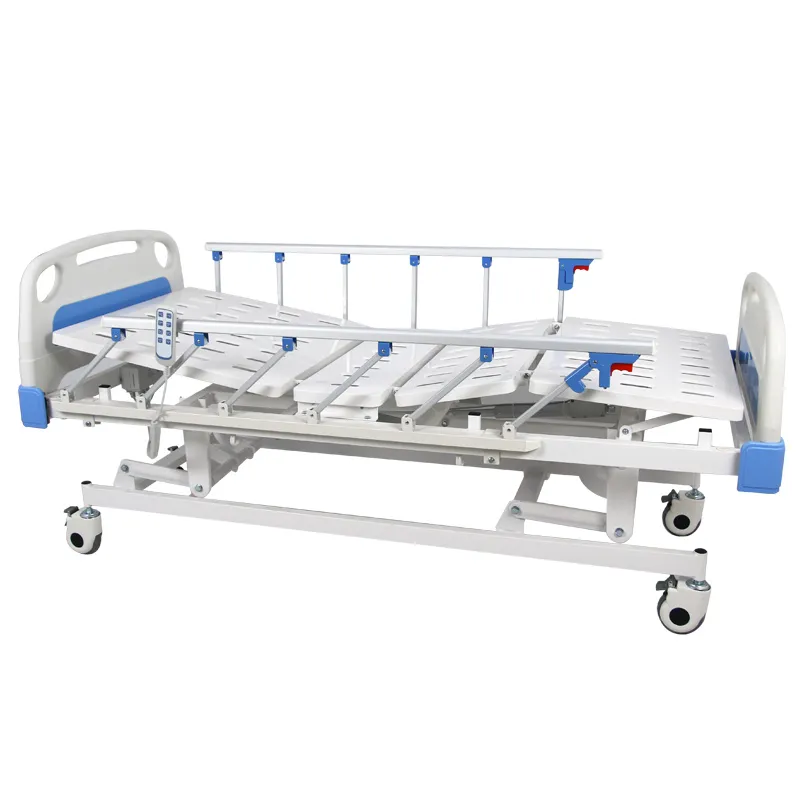
What is an ICU Bed?
An ICU bed is a high-end medical bed specifically designed for intensive care units, used to treat patients with unstable vital signs or those requiring continuous monitoring and supportive treatment.
Unlike the electric beds in regular wards, ICU hospital beds are more than just "beds"; they are comprehensive platforms integrating monitoring, nursing care, treatment support, and safety protection.
The main functions of ICU beds include:
• Electric height adjustment and multi-position adjustment;
• Compatibility with life monitoring equipment and ventilator supports;
• Support for emergency positions (such as the Trendelenburg position);
• Equipped with safety rails, a central brake, and an anti-pinch system;
• One-button reset for convenient emergency operation;
• Anti-static, waterproof, and corrosion-resistant properties.
Therefore, each ICU bed represents not only a patient's place of residence but also a complete life support unit.
Why is it important to scientifically plan the number of ICU beds?
Many people believe that the more ICU beds, the better, but this is not actually the case.
The scientific allocation of ICU beds not only affects the efficiency of hospital resource utilization but also directly relates to patient treatment outcomes.
The main reasons include:
1. Resource Allocation Balance
The ICU is one of the most resource-intensive departments in a hospital, with extremely high investment costs. Too many beds will lead to a waste of equipment, manpower, and space.
2. Nursing Quality and Safety
Each ICU bed requires a corresponding number of nurses and doctors. An unbalanced allocation will result in excessive nursing workload or idle resources.
3. Medical Process Coordination
The number of ICU beds also affects the smoothness of the transition between admissions, discharges, emergency observation, and general wards.
4. Architectural and Spatial Planning Constraints
Intensive care units have strict requirements for space, ventilation, lighting, and electrical systems. Too many beds will affect environmental quality and operational safety.
Therefore, determining the number of ICU beds is a scientific and meticulous planning task.

What factors influence the number of ICU beds in an intensive care unit?
In actual hospital construction or expansion, the number of ICU hospital beds should be determined comprehensively based on multiple factors.
1. Hospital Level and Size
• Tertiary Hospitals: Typically account for 2%–5% of the total number of beds;
• Secondary Hospitals: Generally 1%–3%;
• Specialized Hospitals (e.g., cardiovascular, neurosurgery): The proportion of ICU beds may be higher.
2. Type of Medical Services
General hospital ICUs typically need to cover multiple diseases, while specialized ICUs (e.g., cardiac ICU, neurological ICU) are configured according to departmental needs.
3. Emergency and Surgical Volume
Large hospitals have high emergency and surgical volumes, resulting in a higher demand for ICU beds.
4. Regional Population and Disease Structure
Densely populated areas, aging cities, or areas with a high incidence of serious diseases also have a greater demand for ICU beds.
5. Building and Space Conditions
Each ICU bed requires independent space, tubing, monitoring, and access; therefore, space constraints directly affect the number of beds.
6. Nursing Human Resources
The number of ICU beds also depends on the nurse-to-doctor ratio, generally requiring 2-3 nurses per bed.
These factors collectively determine the scientific range for ICU hospital bed allocation.
How should the number of ICU beds in a critical care unit be calculated?
Although standards vary slightly across different countries or regions, based on medical building design codes and hospital management experience, the following are commonly used calculation methods:
1. Calculation based on the hospital's total bed capacity
General standards:
• ICU beds should account for 2%–5% of the hospital's total bed capacity.
For example:
• A general hospital with 500 beds should have 10–25 ICU beds;
• For large regional hospitals, this can be appropriately increased to 30–40 beds.
2. Calculation based on the service population
Internationally used experience suggests:
• At least 5–8 ICU beds should be provided per 100,000 people.
• This standard considers population size, acute illness incidence, and disease structure, serving as a reference indicator for assessing regional medical resources.
3. Calculated by Departmental Needs
• Certain specialties (such as cardiac surgery and neurosurgery) have a high proportion of critically ill patients after surgery, and their ICU bed allocation ratio is typically higher than average, approximately 10%–15% of surgical beds.
4. Designed by Unit Modules
• Modern ICU wards often adopt a "modular design,"
• Each ICU unit generally contains 6–12 ICU beds,
• This facilitates management and meets manpower allocation standards.

What are the spacing and space requirements between ICU beds?
Besides a reasonable number, the spatial layout between ICU hospital beds is also extremely important.
According to building design codes:
• Minimum clear distance between beds: not less than 2.5 meters;
• Single bed usable area: approximately 20-25 square meters (including equipment area);
• Width of the nursing work area corridor: not less than 2 meters;
• Each bed should be equipped with independent power supply, oxygen supply, and negative pressure suction interfaces.
This layout ensures sufficient operating space for medical staff while also maintaining air circulation and patient privacy.
Therefore, when planning the number of ICU hospital beds, space requirements must be taken into account; otherwise, even with more beds, safe use will be difficult.
Why can't there be "the more the better" for ICU beds?
While more beds may seem to mean stronger treatment capacity, over-provisioning can lead to the following problems:
1. Waste of resources
ICU beds are expensive to build, require a lot of equipment, and have high maintenance costs. High idle rates result in wasted investment.
2. Insufficient manpower
ICU nurses are required in extremely high proportions. If there are many beds but few staff, the quality of care will decrease.
3. Increased Management Complexity
The dispersed nature of beds and the diversity of patients increase the difficulty of coordination and equipment management.
4. Overcrowding and Risk of Cross-Infection
An overly dense layout of ICU beds can easily affect air circulation and disinfection management, increasing the risk of infection.
Therefore, a scientifically sound and reasonable allocation of beds is more valuable than blindly increasing the number.
The Relationship Between the Number of ICU Beds and the Staffing of Medical Personnel
The number of ICU hospital beds must strictly correspond to the ratio of medical personnel to staff.
General Recommendations:
• Nurse-to-bed ratio: 1:1–1:2;
• Doctor-to-bed ratio: 1:4–1:6;
• Support staff (technicians, cleaners, logistics): 2–3 people per 10 beds.
In other words, if an ICU ward has 10 ICU beds, it requires:
• 10–20 professional ICU nurses;
• 2–3 attending and resident physicians;
• Multiple support staff.
If there are too many beds and insufficient staff, it will directly affect nursing safety and resuscitation efficiency.
Standards for ICU Bed Configuration in Different Types
Hospital ICUs are not of a single type. Based on different disease characteristics, they can be subdivided into the following categories, each with its own bed requirements:
ICU Types | Main target groups | Recommended bed allocation | Description |
| General ICU | Critically ill patients of all types | 2% of total hospital beds | Most versatile |
| Cardiac ICU (CCU) | Patients with heart disease or undergoing postoperative care | 10% of cardiovascular beds | Requires ventilator interface |
| Nervous ICU (NICU) | Patients with traumatic brain injury or stroke | 8%–12% of neurology beds | High space and monitoring requirements |
| Respiratory ICU (RICU) | Patients with respiratory failure | 5% of internal medicine beds | High ventilation system configuration |
| Surgical ICU (SICU) | Patients undergoing any type of postoperative care | 10% of surgical beds | Requires proximity to operating room |
Therefore, the number of ICU hospital beds must be planned meticulously based on the specialty and actual needs, rather than a one-size-fits-all approach.
Common Misconceptions in ICU Bed Configuration
In hospital construction practice, the following misconceptions are common:
1. Blindly Pursuing Scale
The belief that more beds equates to greater sophistication ignores the issue of matching personnel with equipment.
2. Ignoring Nursing Workload
Failure to consider the nursing time and operational complexity required for each ICU hospital bed.
3. Inadequate Space Planning
Dense bed density, narrow passageways, and chaotic equipment wiring lead to difficulties in use.
4. Ignoring Functional Zoning
Mixing critically ill patients and those requiring mild intensive care in the same area disrupts management.
These problems often reduce ICU operational efficiency and even increase medical risks.
How to Scientifically Plan the Number of ICU Beds in an Intensive Care Unit?
The scientific allocation of ICU hospital beds should follow these five principles:
1. Demand-Oriented: Calculate based on the hospital's type of patients, number of patients, and proportion of critically ill patients.
2. Human Resources-Based: Ensure sufficient medical staff cover each ICU hospital bed.
3. Spatial Safety-Based: Ensure each bed has independent operating and monitoring space.
4. Equipment Integration-Based: Rationally arrange monitors, ventilators, power interfaces, and emergency exits.
5. Management Efficiency-Based: Maintain a size of 6-12 beds per ICU unit for centralized management.
This planning approach ensures both treatment capacity and efficient operation.
How many beds should an ICU have?
The answer is not a fixed number, but depends on various factors such as hospital size, functional positioning, staffing ratio, and space conditions.
• ICU beds in general hospitals should account for 2%–5% of the total beds;
• Each ICU unit should ideally have 6–12 ICU beds;
• Each ICU bed requires sufficient nursing and monitoring staff;
• Beds should be spaced appropriately apart and equipment should be arranged accordingly.
Scientifically allocating the number of ICU hospital beds can improve medical efficiency while ensuring patient safety and quality of care.
How does Dayang Medical ensure stable production availability?
With two advanced production bases and a well-structured supply chain, Dayang Medical maintains stable year-round production capacity. Our factory in China ensures uninterrupted supply through efficient planning and strict quality control.
Buyers who purchase from us receive reliable lead times, consistent wholesale prices, and access to discount promotions during high-demand seasons. This stability allows distributors and brands to rely on us for continuous product availability.