

As the global population ages, mobility aids have become an essential component of medical rehabilitation, home care, and elderly support. For many individuals facing walking difficulties due to aging, post-operative recovery, neurological conditions, or declining muscle strength, selecting the right mobility aid is not merely a matter of walking efficiency; it directly impacts safety, fall risk, and overall quality of life.
Among the various mobility aids available, crutches and 4-wheel walkers are undoubtedly the most widely used. Many people face the same dilemma when making a choice: Should I choose crutches or a 4-wheel walker? Which offers greater stability? Which is safer? Which is better suited for the elderly, post-operative patients, or those undergoing rehabilitation?
On the surface, both crutches and 4-wheel walkers serve the same core purpose: helping users improve balance, reduce the load on their lower limbs, and enhance walking stability. In reality, however, these two types of devices differ significantly in terms of structural design, target users, stability, mobility efficiency, and the long-term user experience.
Consequently, there is no single, universal answer to the question, "Crutches vs. 4-wheel walkers: which is the best mobility aid?" The right choice depends entirely on the user's physical condition, balance, muscle strength, daily activity levels, and rehabilitation goals.
This article provides a comprehensive comparison of crutches and 4-wheel walkers across multiple dimensions to help you find the mobility aid that best suits your needs.
Why Are Mobility Aids So Important?
Falls represent one of the most common safety risks for the elderly and individuals with mobility impairments. According to World Health Organization statistics, tens of millions of older adults worldwide suffer serious falls each year, with fall-related injuries serving as a leading cause of trauma in this demographic. Hip fractures, in particular, can have devastating consequences, often leading to prolonged bed rest, functional decline, and even a shortened lifespan.
The primary value of mobility aids lies in helping users re-establish a stable support system. When walking, the body's center of gravity constantly shifts between the feet—a process requiring coordinated effort from lower-limb muscles, joints, and the nervous system. When these capabilities diminish, the body becomes more prone to losing its balance. Whether using canes or four-wheel walkers, the fundamental principle is to expand the body's base of support, thereby reducing the risk of falling caused by shifts in the center of gravity.
However, the extent to which the base of support is expanded—and the resulting increase in stability—differs between the two.
What is a cane?
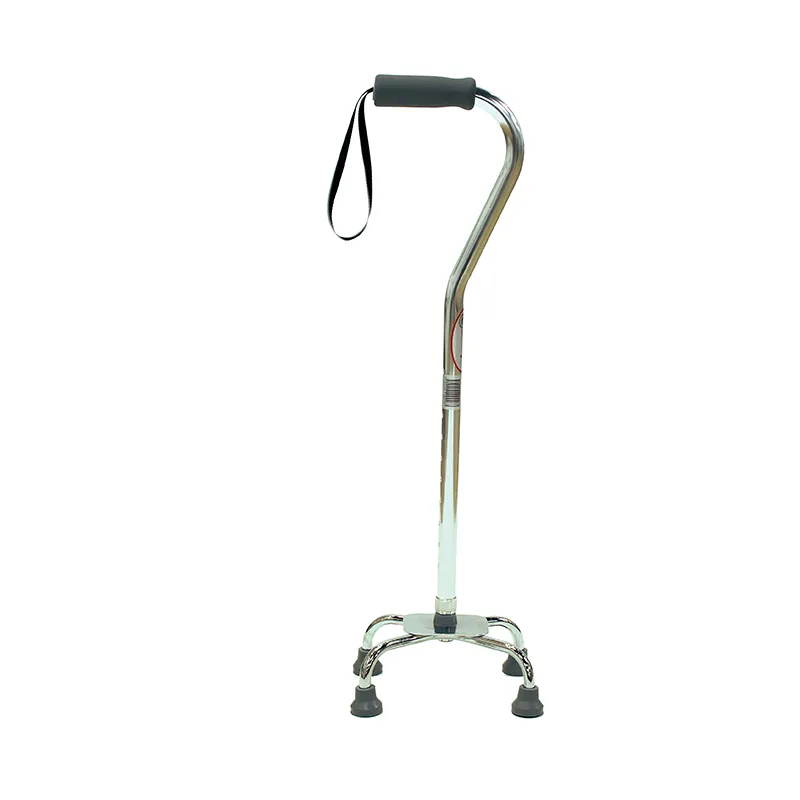
Canes are among the most traditional walking aids, with a long history of use. Modern canes are typically made from lightweight aluminum alloy, steel, or carbon fiber and feature adjustable heights to accommodate users of different statures.
Canes generally fall into several categories:
•Single-point canes
•Quad canes (four-footed canes)
•Forearm crutches
•Underarm crutches
In everyday conversation, the term "cane" usually refers to either a single-point cane or a quad cane.
The primary function of a cane is to help bear some of the body's weight. For individuals with mild balance issues or weakness in one leg, a cane can significantly reduce the load on the affected side. For instance, patients recovering from knee surgery, those who have suffered a mild stroke, or individuals with arthritis often experience improved gait stability when using a cane.
The main advantages of canes are that they are lightweight, portable, and easy to use, as well as relatively inexpensive.
What is a four-wheel walker?
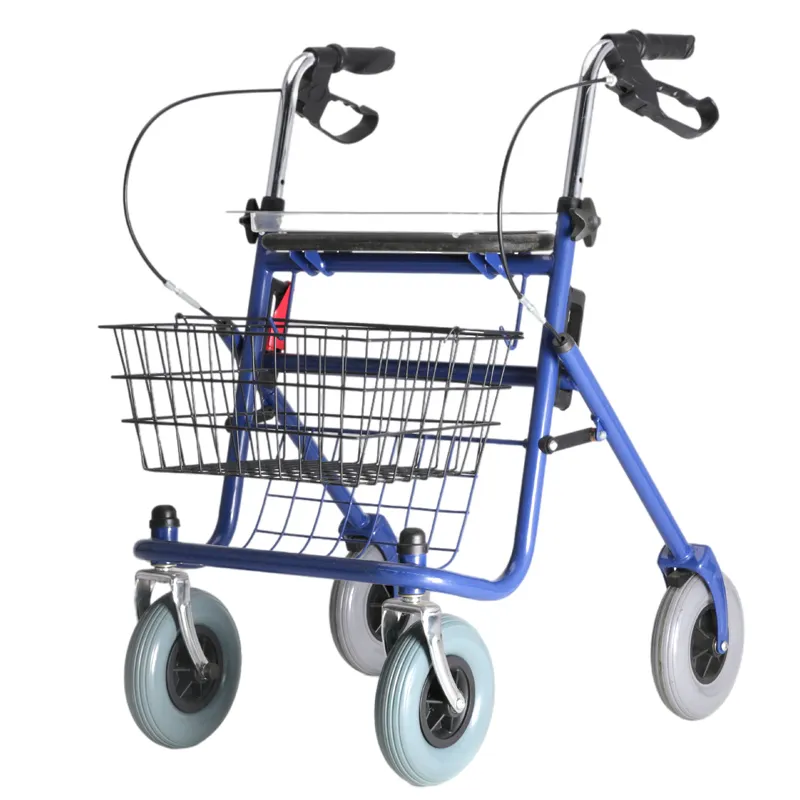
A four-wheel walker—often referred to as a "rollator"—is a walking aid that has gained increasing popularity in recent years.
Unlike traditional walkers, a four-wheel walker features:
•Four wheels
•A hand-brake system
•A seat
•A storage basket or bag
•A foldable design
The defining characteristic of a four-wheel walker is smooth mobility. Because the four wheels roll continuously, users do not need to frequently lift the device to move forward—as is required with traditional walkers—resulting in greater walking efficiency.
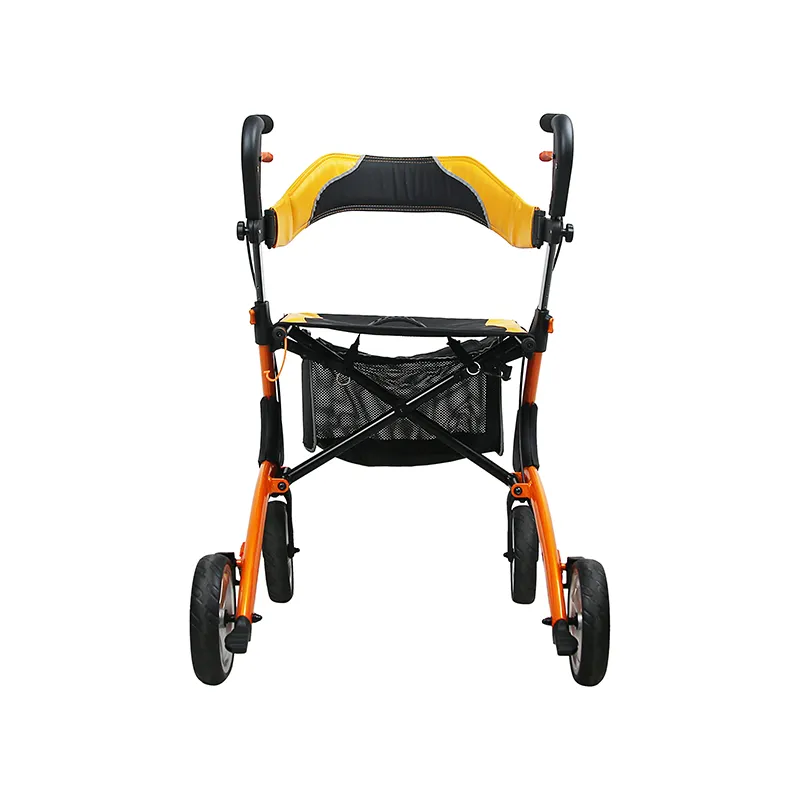
Many high-end four-wheel walkers also come equipped with:
•Non-slip tires
•Advanced braking systems
•Backrests
•Ergonomic handles
These design features make four-wheel walkers particularly suitable for users who need to walk longer distances.
Canes vs. Four-Wheel Walkers: A Comparison of Stability
When comparing canes and four-wheel walkers, stability is usually the first factor people consider.
The answer is clear: in the vast majority of cases, a four-wheel walker offers greater stability than a cane. Stability is fundamentally determined by the size of the support base. Canes provide additional support at one or more specific points. Even with a quad cane (four-footed cane), the base of support remains limited, meaning the user's legs must still bear the majority of their body weight. In contrast, a four-wheeled walker offers a large support structure positioned in front of the user. By gripping the handlebars with both hands and leaning forward, the user can transfer more of their weight onto the device.
From a biomechanical perspective:
•Canes add a limited number of support points.
•Four-wheeled walkers expand the overall base of support.
Therefore, four-wheeled walkers offer a distinct advantage for individuals with poor balance.
Who needs high stability the most?
Four-wheeled walkers are generally more suitable for:
•Elderly individuals with poor balance
•Patients with Parkinson's disease
•Individuals with weakness in both legs
•Patients with chronic neurodegenerative diseases
For instance, patients with Parkinson's disease often experience "freezing of gait" and a forward-leaning posture; canes alone struggle to provide adequate support, whereas four-wheeled walkers make it easier for them to maintain their balance.
Canes vs. Four-Wheeled Walkers: A Comparison of Maneuverability
High stability does not guarantee overall superiority, as maneuverability is another crucial factor for mobility aids.
In this regard, canes hold a clear advantage.
Canes are compact, making them suitable for:
•Narrow corridors
•Staircases
•Turning in tight spaces
•Public transportation
While four-wheeled walkers move smoothly, they take up more space. In confined areas—such as small bathrooms, corridors in older apartment buildings, or stairwells—a four-wheeled walker can actually become a hindrance.
For individuals who frequently need to navigate stairs, canes are generally more practical than four-wheeled walkers.
This is why many rehabilitation specialists say:
Canes excel in maneuverability, while four-wheeled walkers excel in stability.

Canes vs. Four-Wheeled Walkers: Impact on Physical Exertion
Mobility aids affect not only safety but also the amount of physical effort required.
Many people mistakenly assume that because canes are lighter, they require less effort to use. In reality, this is not necessarily the case. When using crutches, the user must constantly:
•Lift the crutch
•Place the crutch down
•Coordinate their gait
•Maintain balance
This places significant demands on the shoulders, forearms, and core muscles.
In contrast, the wheels of a 4-wheel walker roll continuously, resulting in relatively low resistance to movement; the user simply needs to give it a gentle push to move forward.
Studies show that for medium-to-long-distance walking, 4-wheel walkers can reduce energy expenditure by approximately 10% to 30%—a benefit that is particularly pronounced for elderly individuals with limited cardiopulmonary endurance.
The Resting Advantage of 4-Wheel Walkers
This is a feature that crutches cannot replicate.
Many 4-wheel walkers come equipped with a seat. Users can sit down and rest immediately when tired, which is crucial for individuals with:
•COPD (Chronic Obstructive Pulmonary Disease)
•Heart failure
•Low physical stamina
For instance, patients with COPD often struggle to walk for extended periods due to shortness of breath; the built-in seat of a 4-wheel walker significantly improves their ability to go out.
Which mobility aid is better for the elderly?
It depends on the individual's physical condition. If an elderly person has only a mild decline in balance and no significant muscle weakness, crutches may suffice.
However, if the elderly person experiences:
•Frequent staggering
•A tendency to fall
•A noticeable decrease in walking speed
•Insufficient leg strength
Then a 4-wheel walker is usually a more suitable choice.
Research on fall prevention indicates that the use of stable mobility aids can reduce fall rates among the elderly by approximately 20% to 40%. This is why elderly care facilities increasingly recommend 4-wheel walkers.
Which mobility aid is better for post-operative rehabilitation?
Patients undergoing post-operative rehabilitation are a major user group for mobility aids.
Examples include:
•Post-hip replacement
•Post-knee replacement
•Post-spinal surgery
These patients typically require assistance that evolves through different stages.
In the early stages of recovery, stability is the priority, making 4-wheel walkers more common. As rehabilitation progresses and muscle strength returns, many patients gradually transition from a 4-wheel walker to crutches.
In other words, crutches and 4-wheel walkers are not strictly in competition; rather, they often serve as tools for different stages of the rehabilitation process.
Common progression during rehabilitation
The typical progression path is:
Bed rest → Walker → 4-wheel rollator → Crutches → Independent walking
Therefore, in rehabilitation medicine, the 4-wheel rollator and crutches often serve as successive stages in recovery rather than being mutually exclusive options.
Price comparison: Which is more cost-effective—crutches or a 4-wheel rollator?
In terms of cost, crutches have a clear advantage.
Standard crutches are generally inexpensive, whereas 4-wheel rollators, due to their complex structure, usually come with a higher price tag.
However, "cheap" does not necessarily mean "better value." If using unsuitable equipment leads to a fall, the cost of treating a single fracture could far exceed the price of the equipment itself.
Therefore, when making a choice, consider the following rather than just the price:
•Safety
•Suitability
•Long-term value
Who should not use a 4-wheel rollator?
Although 4-wheel rollators offer significant advantages, they are not suitable for everyone.
Caution is advised for the following groups:
1. Individuals with poor upper-limb control
If one cannot firmly grip the brakes, the risk of accidents increases.
2. Patients with severe cognitive impairment
Individuals with Alzheimer's disease, for example, may not understand how to operate the braking system.
3. Individuals unable to control their walking speed
Patients with certain neurological conditions may exhibit a "festinating gait" (involuntarily accelerating while walking); in such cases, the rollator could be pushed out of control.
Who should not use crutches?
Crutches are not a universal solution.
Using crutches alone is not recommended in the following situations:
•Significant weakness in both legs
•Severe balance disorders
•History of frequent falls
•Severe vertigo
Users in these categories often underestimate the risks involved if they insist on using crutches.
FAQ
Which is safer: crutches or a 4-wheel rollator?
Generally, a 4-wheel rollator is safer because it offers a larger base of support and greater stability.
Should elderly individuals buy a 4-wheel rollator right away?
Not necessarily; the decision should be based on their balance ability and leg strength.
Can a 4-wheel rollator be used on stairs?
Most 4-wheel rollators are not suitable for use on stairs.
Can crutches replace a 4-wheel rollator?
It is suitable for mild mobility impairments, but generally not recommended for moderate to severe balance issues.
Which assistive walking device should be chosen for postoperative recovery?
A four-wheeled walker is usually more suitable during the early stages of rehabilitation, with a gradual transition to crutches as recovery progresses.