

When caring for the elderly, long-term bedridden patients, patients in recovery, and those with limited mobility, "safe transfer" is always one of the most crucial steps.
To reduce the physical burden on caregivers and minimize the risk of secondary injury to patients, more and more families and nursing homes are starting to use patient transfer chairs, also known as "patient transfer machines, patient transfer devices, or patient bed-chair transfer devices."
Many caregivers and families are most concerned about whether a patient transfer chair can be operated independently by one person.
This question is very important because it relates to nursing efficiency, safety, and ease of use.
This article will comprehensively analyze whether "one person can operate it" from a professional nursing perspective and systematically explain the structure, function, safety precautions, and applicable population of the patient transfer chair, helping you truly understand how to use this equipment scientifically.
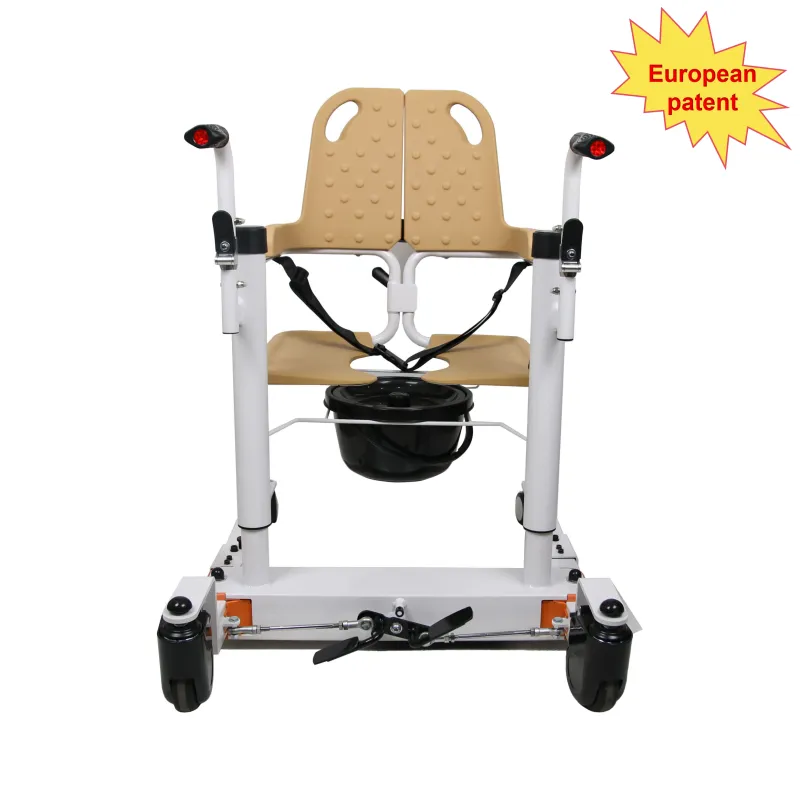
What exactly is a patient transfer chair?
Before answering whether it can be operated by one person, we must first correctly understand what a patient transfer chair is.
From a professional definition:
A patient transfer chair is a nursing aid that uses mechanical power (hydraulic, manual, electric) to safely lift and transfer a patient from a bed, wheelchair, chair, floor, or medical equipment.
It is mainly used for:
• Assisting bedridden patients to wheelchairs
• Assisting elderly or recovering patients from sitting to standing
• Assisting caregivers with daily bathing, toileting, and relocation
• Reducing the physical burden on caregivers
• Preventing injuries from patient falls or relocations
The core value of a patient transfer chair lies in—
Making the two most burdensome actions for caregivers—"lifting + transferring"—easy, safe, and controllable.
Therefore, understanding its structure and usage is a prerequisite for determining whether it can be operated by a single person.
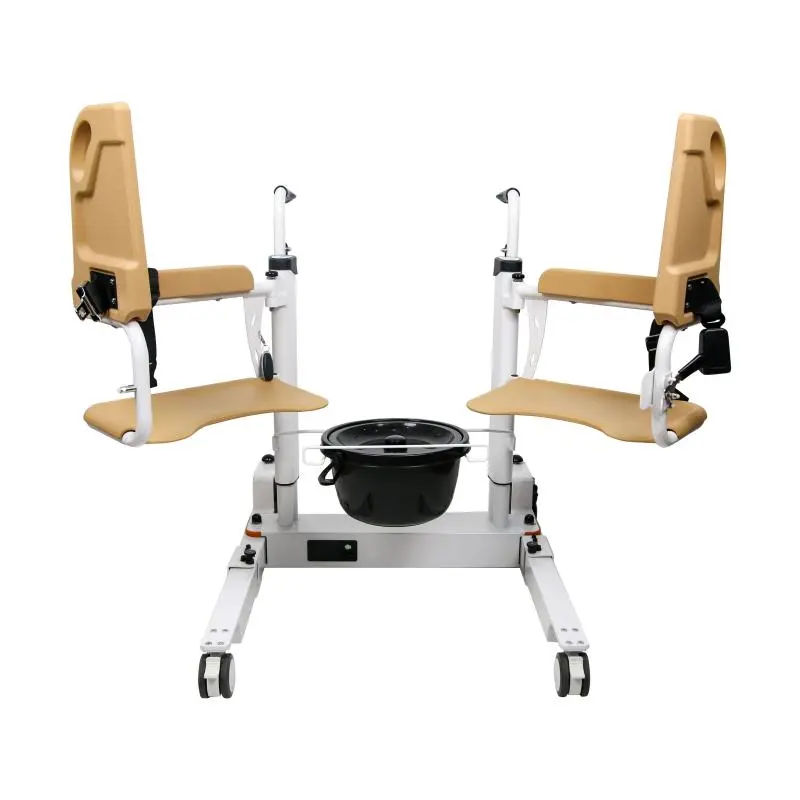
What is the structure of a patient transfer chair?
To understand its operational difficulty, it is necessary to first understand the structural components of a patient transfer chair.
A typical patient transfer chair mainly consists of the following parts:
1. Lifting Boom
The core support structure used to lift the patient.
2. Base & Casters
Responsible for movement and maintaining stability. Some models have adjustable base widths to accommodate different beds or chairs.
3. Slings or Hoops
In direct contact with the patient, used to wrap or support the body.
4. Drive Method (Hydraulic or Electric)
• Manual Hydraulic: Lifting via foot pedal
• Electric Lifting: Lifting and lowering using an electronic control button
5. Control Unit
Electric models are equipped with a hand controller for easy lifting and lowering.
6. Safety Lock and Emergency Lowering Device
Ensuring no sudden descent or loss of control during use.
These structural elements collectively determine whether a patient transfer chair can be safely operated by one person.
Can a caregiver operate a patient transfer chair?
In most cases, one person can operate a patient transfer chair, but the following prerequisites must be met:
1. The operator is properly trained
Any nursing equipment requires proper operation; otherwise, it can be dangerous.
2. A standard-designed patient transfer chair is used
Compliant, stable, and structurally sound equipment ensures safety.
3. The patient's physical condition is suitable for operation
Some patients are unstable, have abnormal muscle tone, or are unconscious, requiring two people to operate the equipment.
4. Sufficient space is required for operation
Narrow spaces limit the opening, rotation, and movement of the base.
5. The caregiver has basic strength and control
Moving the equipment still requires relatively little effort to control direction and speed.
Therefore, the patient transfer chair is designed to allow for single-person operation, but this does not mean it is suitable for single-person operation in all situations.
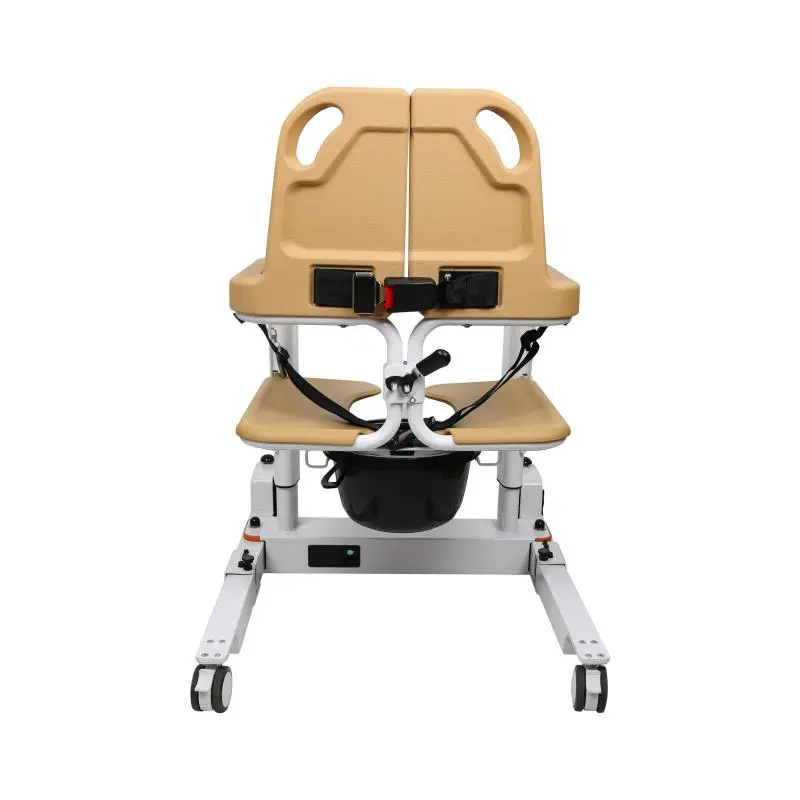
Which patient transfer chair models are suitable for one-person operation?
Different designs of patient transfer chairs determine the operation method. The types most suitable for single-person operation are typically:
1. Electric patient transfer chair
Advantages:
One-button height adjustment
Easy operation
High controllability
More suitable for caregivers with insufficient strength
Electric models are suitable for home and nursing facilities, especially for single-person care.
2. Wide-Base Adjustable Transfer Chair
Flexible operation, adaptable to different beds, chairs, and wheelchairs.
3. Model with Multi-Point Support Slings
Reduces patient swaying and makes it easier for one person to stabilize the slings.
These models are ergonomically designed for efficient and safe single-person operation.
When is it not recommended to operate the patient transfer chair alone?
Although the equipment supports single-person operation, at least two people should work together in the following situations:
1. The patient cannot maintain basic sitting or lying stability.
For example, convulsions, violent struggles, rigidity, or loss of consciousness.
2. The patient is severely obese (exceeding the equipment's rated load).
3. The caregiver has limited physical strength or mobility.
4. The space is too small to properly use the slings or base.
5. First-time use, or the caregiver is unfamiliar with the equipment's operation.
6. More precise positioning adjustments are required, such as bathroom transfers.
In these situations, having an additional person can better protect the safety of both the patient and the caregiver.
What conditions are required for a single person to operate a patient transfer chair?
To ensure safe operation by a single person, the following requirements must be met:
1. Correct harness donning technique
The correct installation of the harness directly determines safety.
2. Familiarity with the equipment control methods
For example:
• How to raise and lower
• How to brake
• How to move
• Where is the emergency descent button?
3. Properly prepared environment
The floor should be dry and level to avoid tripping or the wheels getting stuck.
4. The patient can understand and cooperate with the operation
For example, keeping the body relaxed and avoiding unnecessary hand movements.
5. The caregiver possesses basic strength and stable control abilities
These conditions are indispensable.
What are the standard procedures for a nurse operating a patient transfer chair?
Below is a professional nursing procedure (physical operation only, not a case study):
Step 1: Preparation and Inspection
• Check patient transfer chair battery
• Check sling for damage
• Open base to appropriate width
• Clear floor obstructions
Step 2: Communicate with Patient
Inform the patient that a transfer is about to take place and ensure their relaxation and cooperation.
Step 3: Correctly Install Sling
Depending on the model, place the sling under the patient's back, legs, or body.
Step 4: Raise Patient
• Slowly raise using buttons or hydraulic pressure
• Observe patient stability
• Ensure sling does not slip
Step 5: Move the Equipment to the Target Position
Move slowly and steadily.
Step 6: Lower to a Safe Position
• Slowly lower
• Adjust seating posture
• Remove sling
Step 7: Tidy Up the Equipment
Ensure the patient transfer chair is returned to its original position for future use.
The above procedure is designed for single-person operation but requires proficiency.
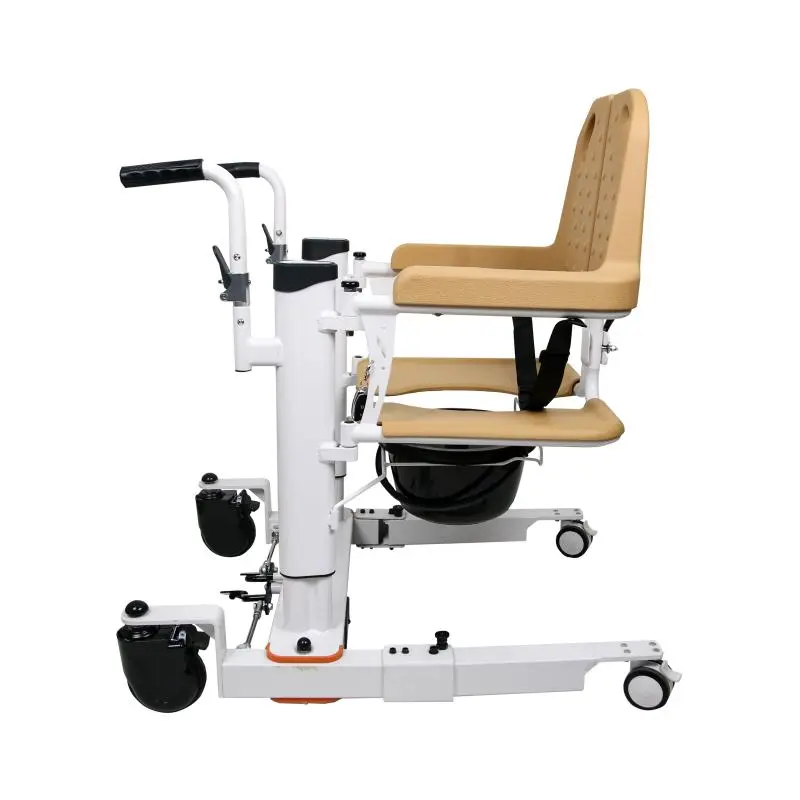
What safety points should a caregiver pay most attention to when using a patient transfer chair?
To ensure safety when operating alone, the following precautions must be taken:
1. Do not allow the patient to move during the raising and lowering process.
Inform the patient of the procedure beforehand.
2. Ensure the sling model is completely compatible with the patient transfer chair.
Different brands and models are not interchangeable.
3. Observe the patient's body force and posture during the raising process.
4. Never pull the equipment at an angle or push or pull suddenly.
5. Avoid operating on wet, slippery, or uneven surfaces.
6. Keep both feet stable and avoid leaning forward during operation.
Prevent injury to the caregiver.
These safety points are crucial in determining whether solo operation is possible.
Which nursing scenarios are best suited for one-person operation of the patient transfer chair?
The following scenarios are best suited for one-person operation:
• Transfer from bed to wheelchair
• Transfer from wheelchair to chair
• Adjusting from a lying position to a sitting position
• Routine transfers in daily care
• Repetitive transfer movements for long-term bedridden patients
More complex scenarios, such as transfers in the bathroom or picking up items from the floor, may require two people.
Why does a patient transfer chair make single-person operation possible?
This is because a patient transfer chair possesses the following advantages:
1. Mechanically amplified force
The caregiver does not need to lift the patient; they only guide the movement of the equipment.
2. Stable structure, less prone to tipping
The base design ensures stability.
3. Electric lifting significantly reduces manpower requirements.
4. Slings wrap around the body structure, improving safety.
5. Easy movement and controllable direction
Compared to traditional carrying methods, a patient transfer chair reduces manpower requirements by almost 90%.
What are the advantages of single-person operation of a patient transfer chair?
1. Reduced physical burden on the caregiver
Especially suitable for female caregivers or family caregivers.
2. Improved safety
Prevents patient falls and caregiver lumbar spine injuries.
3. Increased nursing efficiency
One person can complete tasks that previously required two people.
4. Enables professional-level care at home
5. Increased patient comfort
Smooth lifting and lowering, unaffected by sudden swaying.
"Can one person operate a patient transfer chair?"
The answer is: Under most appropriate conditions, yes.
As long as the equipment is properly designed, the caregiver is trained, the environment is suitable, and the patient can cooperate to a basic extent, most common transfer tasks can be safely completed by one caregiver.
How reliable is Dayang Medical for international medical purchasing?
Guangdong Dayang Medical Technology Co., Ltd. is a reliable manufacturer and supplier for international medical purchasing. Established in 2009, we produce electric wheelchairs, manual wheelchairs, sports wheelchairs, hospital beds, shower chairs, commodes, walking aids, and canes. Our two R&D and production bases guarantee high-quality products certified under ISO13485, ISO9001, FDA, TUV, and CE. Buyers can purchase customized or standard units, wholesale orders, and enjoy promotions, competitive pricing, and direct factory sourcing.