

In modern medical and home care environments, patient transfer and relocation remain a core and unavoidable issue. With the increasing specialization of nursing equipment, lift transfer chairs have gradually become important auxiliary tools for moving patients between beds, wheelchairs, toilets, and other locations.
At the same time, a frequently asked question arises: Can I use a Patient Lift Transfer Chair independently?
This question, seemingly simple, actually involves several professional aspects, including:
• The structure and functional positioning of the lift transfer chair
• The user's physical capabilities
• Nursing safety and risk control
• The true meaning of "independent use" in the context of nursing equipment
This article will systematically and rigorously analyze this question from the perspective of professional nursing equipment, helping readers to obtain a clear and rational answer based on an understanding of the functional boundaries of lift transfer chairs.
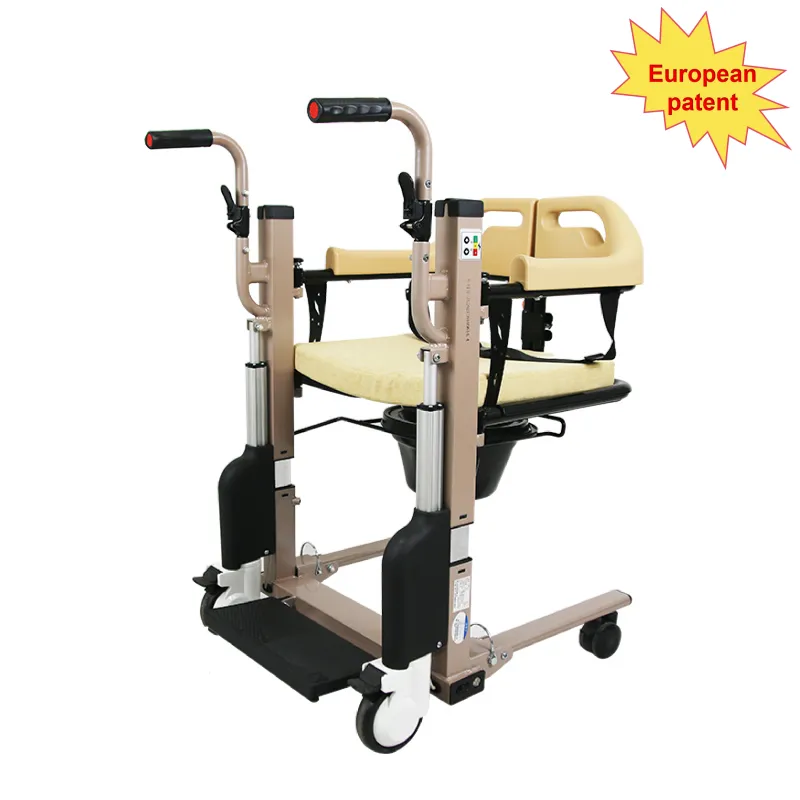
What is a Patient Lift Transfer Chair?
A lift transfer chair is a nursing device with height adjustment functions used for the seated transfer and relocation of patients. In professional classification, a lift transfer chair is generally considered an enhanced form of patient transfer chair, its core feature being the combination of "lifting" and "transfer" functions.
Structurally, a lift transfer chair typically possesses the following basic characteristics:
• An adjustable height seating system
• A stable base and casters
• Armrests or handles for short-distance movement
• A design that facilitates proximity to the bed, toilet, or wheelchair.
The primary purpose of a lift transfer chair is not for prolonged sitting, but rather to assist patients in safely transitioning between different height levels.
What is the main design purpose of a lift transfer chair?
To answer the question "Can a lift transfer chair be used independently?", we must first understand a crucial premise: Who is a lift transfer chair designed for?
From the perspective of professional nursing equipment design logic, the core design objectives of a lift transfer chair include:
• Reducing the risk of falls during patient transfer
• Reducing the physical burden on caregivers during transport
• Improving the efficiency of connections between beds, chairs, toilets, and other facilities
• Achieving controllable and stable seated transfers within limited spaces.
Therefore, in terms of functional positioning, a lift transfer chair leans more towards "nursing assistance equipment" rather than a fully independent personal mobility device.
Can I use a lift transfer chair alone?
—— From a design perspective, does a lift transfer chair support independent use?
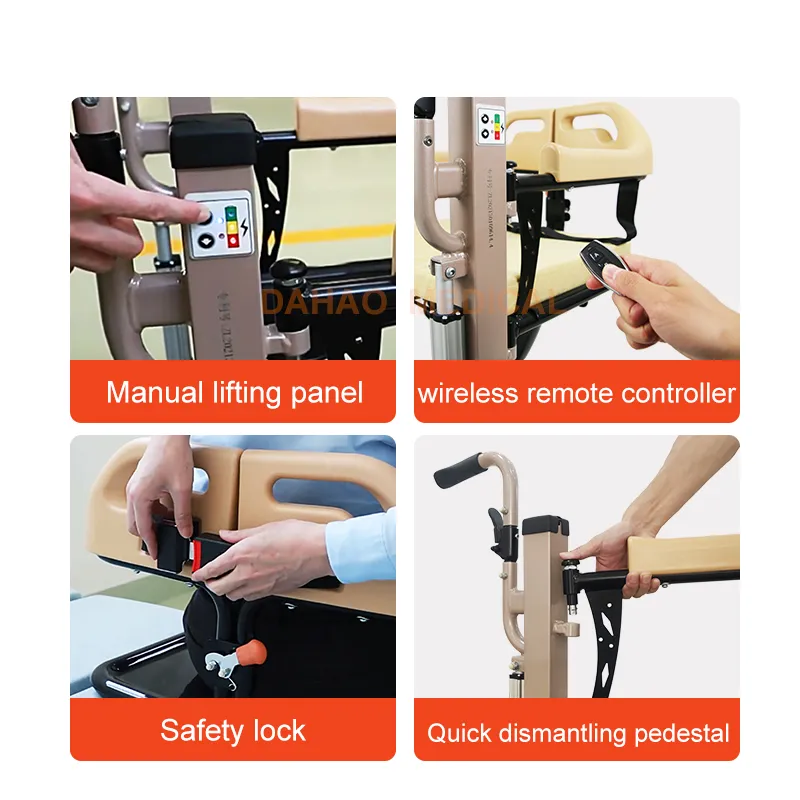
Most lift transfer chairs are designed with the presence of caregivers or companions in mind. This is reflected in several details:
• The pushing mechanism is usually located at the back of the chair
• Brakes and height controls are often more suitable for standing users
• The chair's center of gravity is designed for stability during pushing.
Therefore, from its initial design intent, a lift transfer chair was not entirely created for "independent use."
What does "independent use" mean in the context of a lift transfer chair?
When discussing the ability to use a lift transfer chair independently, the concept of "independent use" itself must be clearly defined.
In the field of nursing equipment, "independent use" typically includes the following scenarios:
1. The user completes the transfer without any assistance.
2. The user independently sits down, raises, lowers, and gets out of the chair.
3. The user independently controls the direction of movement during the transfer.
However, it is important to emphasize that a lift transfer chair is not the same as a self-propelled wheelchair. Even if some users have a certain level of mobility, it does not mean that a lift transfer chair is inherently suitable for completely independent operation.
What physical conditions affect the ability to use a lift transfer chair independently?
From a professional nursing assessment perspective, the ability to use a lift transfer chair independently is usually closely related to the following physical conditions:
• Ability to maintain a stable sitting posture
• Ability to stand or semi-stand for short periods
• Sufficient upper limb strength for support and control
• Sufficient balance to cope with changes in height
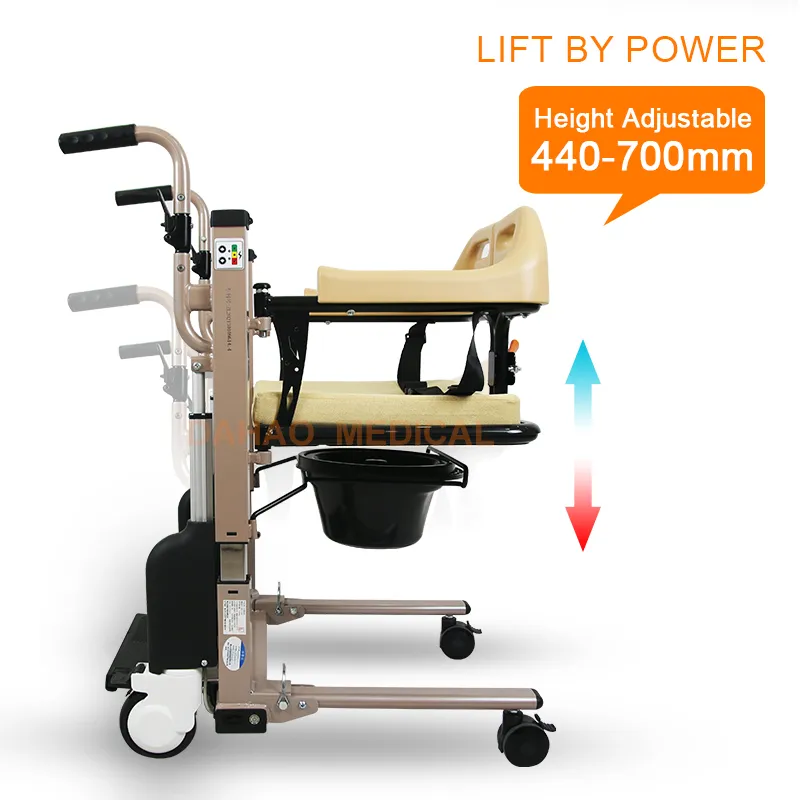
During raising, lowering, and transfer, the center of gravity of the lift transfer chair shifts. If the user cannot effectively respond to these shifts, there are significant risks associated with using the lift transfer chair independently.
Is a lift transfer chair suitable for fully autonomous operation?
From a rigorous and professional nursing safety perspective, the answer is: in most cases, it is not recommended to consider a lift transfer chair as a fully autonomous operation device.
The reason is not that lift transfer chairs are "unsafe," but rather that their safety is often based on proper use. One crucial prerequisite is the assistance or supervision of another person during critical operation phases.
The safety advantages of a lift transfer chair are primarily reflected in:
• Stability when pushed by someone
• Controllability of operation when assisted
• Risk warning capability when observed
Why does a lift transfer chair usually require assistance?
This is a question many users easily overlook when trying to understand lift transfer chairs.
1. The lifting motion itself requires stable control
Whether manual or mechanical, lift transfer chairs place higher demands on the user's balance during height changes. Assistance from another person can provide support and correction at critical moments.
2. Unforeseen factors exist during the transfer process
Ground conditions, space limitations, and differences in equipment docking height can all affect the transfer process. Assistance from another person helps in timely adjustments to the operation method.
3. Nursing Equipment Emphasizes "Risk Minimization"
In the design philosophy of nursing equipment, safety takes precedence over convenience. The logic behind using a lift transfer chair is precisely based on "minimizing the risk of accidents as much as possible."
What is the difference between a lift transfer chair and a self-propelled wheelchair in terms of user autonomy?
This is a key point of comparison for understanding "whether a lift transfer chair can be used independently."
• Self-propelled wheelchair: Focuses on user self-control
• Lift transfer chair: Focuses on safe transfer and nursing assistance
The lift transfer chair does not aim for prolonged independent movement, but rather for completing safe and stable transfer tasks in a short time. Therefore, their design orientations regarding user autonomy are fundamentally different.
In what situations is it less suitable to use a lift transfer chair independently?
From a professional perspective, the following situations are generally unsuitable for independent use of a lift transfer chair:
• Transfer operations requiring frequent height adjustments
• Significant height differences during transfer
• Insufficient user balance
• Limited space in the usage environment
In these situations, the advantages of a lift transfer chair are precisely what require assistance from others to be fully realized.
How to correctly understand the "boundaries" of lift transfer chair use?
Understanding the limitations of lift transfer chair usage is crucial for safe use.
The core value of a lift transfer chair lies in:
• Enhancing the transfer process;
• Making nursing procedures less strenuous;
• Making transfer movements more controllable.
It is not about completely replacing nursing staff. Viewing a lift transfer chair as a "device that can be operated entirely independently" deviates from its professional purpose.
Can I use a Patient Lift Transfer Chair independently?
In most nursing scenarios, it is not recommended to use a Patient Lift Transfer Chair entirely independently.
The design goal of a lift transfer chair is to make patient transfer safer, more stable, and more efficient with assistance or supervision. Understanding this correctly is essential to truly realizing the value of a lift transfer chair in the nursing system.
If you are evaluating how to use a lift transfer chair, it is recommended to always consider safety, controllability, and nursing professionalism, rather than simply pursuing "whether it can be operated independently."
Can I buy high-quality hospital beds from Dayang Medical?
Yes. Guangdong Dayang Medical Technology Co., Ltd. provides high-quality hospital beds, ideal for medical facilities and home care. Founded in 2009, we are a professional manufacturer and supplier offering electric wheelchairs, manual wheelchairs, sports wheelchairs, shower chairs, commodes, walking aids, and canes. Our two R&D and production bases ensure strict quality control, certified under ISO13485, ISO9001, FDA, TUV, and CE standards.